Monday, 2 January 2023

Guinness World Record: Punching Above My Weight

 GUINNESS ATTEMPT: PUNCHING ABOVE MY WEIGHT

Note To The Readers

When I attempted (successfully) to break the existing Guinness record for fastest cycling from Leh to Manali, I did not know what would be the result. All I wanted was to attempt it and if nothing more, create a memorable experience with my crew. I say it with conviction that if I could achieve this, anyone with the right intent can do it and it's no exaggeration. In the aftermath of the event, many people wanted to know the experience of the ride including the preparation stage. It has taken me a long time to finally sit down and write it all in this piece. It is my opinion that the Guinness ride should not be seen in isolation because the events that preceded the ride are equally (if not more) important to understand the real significance of the Leh-Manali ride. By means of this write-up, I do not intend to get into a self-glorification mode but since it is a first-person account, I will talk about it from my perspective. This will be as honest an account as can be and it is a testimony to what a human body can achieve if the circumstances and people align themselves in facilitating what is sought with a passionate fervour. A few people will figure repeatedly in my write-up, so a brief about them:

Ramya - My wife

AK Sir - My ex CO and a mentor and Guide

Satish Sir - Veteran Cyclist and a Guru

Pradeep Sir - My ex CO and a Josh box

Nitin Sir - Elite PARA officer and an ultra athlete

Sumit Patil - Ultra Cyclist and a super human being

Kedar Joshi - Extremely spirited Coursemate

Tanvi - Cycling friend and coffee expert. Owns Metta Cafe in Leh.

Kabir - As per me, the best Ultra cyclist in India right now.

Bharat Pannu - A senior and an ultra cyclist with multiple Guinness records under his belt.

A few terminologies which might confuse you from time to time:

RAAM - Race Across America. An annual event and supposedly the toughest cycling race in the world.

RAAM Qualifier - An event that, if completed in time, makes one eligible to participate in RAAM.

Brevet (BRM) - Organised rides of 200/300/400/600/1000/1200 km which are officially logged and recognised.

Super Randonneur (SR) - The title one gets if he/she completes 200, 300, 400 & 600 km in a cycling calendar year, which runs from 1 November to 31 October.

Brevity is not a virtue I possess and honestly it would be an injustice to rush over this entire experience. Each event is linked to another, so stay with me, ride this experience and feel free to share your feedback.

‘Skills are cheap, Passion is priceless’


PROLOGUE

It was a pleasant Sunday morning and I had a certain ‘feel-good’ vibe while cycling to Khardung La. I had earlier attempted to scale Khardung La but had returned from South Pullu. Today I was certain of going the distance. About 3 km short of the top, I had to navigate a kilometre-long sandy and rocky patch and I made a mental note to dismount from my bike while riding down so as to avoid slipping on this tricky stretch. Once on the top, I felt exhilarated. I had cycled 80 kilometres from Karu till here in a decent time and as per my expected timelines. After a quick refilling of water and a mandatory photoshoot, I started on the descent which extended all the way to Choglamsar past Leh. Riding down at speeds in excess of 60 kmph, I felt a cold shiver because of the winds. My palms inside the gloves were getting numb from holding on to the brake lever continuously too. Before I could realise, I was staring ahead at that same sandy patch which I had noticed during my uphill climb and with no reaction time whatsoever, my bike started slipping on the loose sand and stones, and hit pothole after pothole. I lost complete control of my bike and the brake levers seemed to have surrendered too. Upon doing some quick thinking in those frenetic moments, I decided to steer my bike to the left so as to avoid the sheer fall into the valley on the right. As I steered left, huge boulders and the mountain side looked me straight in the eye. I said a quick prayer and braced for the impending impact. I crashed into the boulders and flew off the bike.


Cycling Scene Post ‘Super Randonneur’ Status

I had picked up cycling in the winter of 2018 and completed my SR in September 2019. That journey has been detailed in my previous post (link here - https://ikki377.blogspot.com/2019/10/from-being-noob-to-super-randonneur-my.html). After the SR, I continued participating in brevets in Jaipur and I did really enjoy the vibrant cycling community there. Rides were fun and challenging too. In February 2020, I attempted a 1000 km brevet organised by the Bathinda Randonneurs. That was my first taste of long-distance riding combined with sleep deprivation. The route had good elevation gain and felt challenging to me. I completed the ride in 68 hours but not before succumbing to serious hallucinations and mind-freeze moments in the last 100 km because of an acute paucity of sleep. All in all, a good learning experience.

Then of course we were all hit by COVID and outdoor rides stalled completely. At around the same time, I got posted out of Rajasthan. I had also started thinking about what direction to take after doing the brevets. Was it not the logical step to probably raise the bar and do something more challenging? I mean, brevets are fine. Great to ride in groups and share a sense of camaraderie with a group who share a common love for cycling but they are not too challenging and demanding on the body and the rider’s skill sets. And I got in touch with Lt Col Bharat Pannu who was already a known name in the Indian Ultra cycling scene. He had just participated in the virtual RAAM and got a podium finish which was no mean feat. He also held the Guinness record for fastest cycling from Kashmir to Kanyakumari. I surmised that he could probably give me a little guidance to align me to the ultra cycling field. I spoke to him and he did guide me but of course I was an unknown entity to him and it wasn’t possible for him to really understand what I was capable of and what to suggest. 

24 Hours Virtual Time Trial (VTT)

A few days later, he sent me a link to a virtual cycling competition. It was called Virtual Time Trial (VTT) and was being organised on Independence Day by a group who called themselves ‘Irregulars’! Sumit Patil, Hitisha and Tanvi were part of the organising team among others. There were 3 categories - 6, 12 & 24 hours. I registered for the 24-hour category and the requirement was to ride for 24 hours and achieve at least 680 km for anyone to be a finisher. We needed indoor trainers for the event and I managed to get a used trainer just a week prior to the event and somehow did the bare minimum to get acquainted with indoor riding. We were 7 riders in the 24-hour category and I did not know any of them. We started promptly at 6 AM with an aim to ride till 6 AM on the morrow and clock 680 km. We were doing the ride on Zwift and it was a loop of 17 km that had to be repeated. I clocked 611 km and stood 4th. Wasn’t easy, especially managing what and when to eat and drink. To put things into perspective, Mayank clocked 771 km and Kabir clocked 751 km. These were some of the top riders in India. I did feel a sense of accomplishment. My first Ultra ride!


5-Day SR (200, 300, 400 & 600 km in 5 days)

In February 2021, I signed up for a 5-day SR organised by the Jalandhar Randonneurs. Rohit bhai was the organiser and I had done a 400 km brevet earlier with them. The hospitality of Punjab is well known yet I was still awed by their excellent conduct. This 5-day SR was to begin with a 600 km ride which was mostly in the Punjab plains without any major climbs. It was to be followed by a 300 km ride to Baba Balak Nath Temple near Una, Himachal Pradesh and it was a challenging route with good elevation gain. Then came the 400 km ride from Jalandhar through Pathankot, Dharamsala, Kangra, Jwala Ji and Chintpurni back to Jalandhar. This ride really tested us all. Not only was the elevation gain a factor, but the bad roads in Himachal added to our fatigue and toughness quotient. There were 5 of us doing the entire SR series - Kanwar, Grinshina, Ramanpreet, Renu ma’am and myself, and we stuck together for the entire route and managed to complete it just in time. Within a couple of hours of completing this ride, we had to commence our 200 km ride to Chintpurni Temple which again had a lot of climbing! Finally, by about midnight, we finished the ride and there was a lot of jubilation and joy at the culmination which we signed off with a well-deserved party.

The 5-day SR was my first real taste of mountains and this quantum of climbing had never been attempted by me before. It was undoubtedly a tough 1500 km in 5 days and not only did it provide satisfaction but was also a revelation to me that I needed to work on my climbing abilities.


La La Land Ultra

It was May 2021 and I was making plans to participate in a ‘Manali-Turtuk’ bike race called the La La Land Ultra. It was a 700 km race which was required to be completed in 100 hours to be a successful finisher. This was also being organised by ‘Irregulars’ and was the longest Ultra ride in the mountains being organised anywhere in the world. I was discussing some of the finer aspects of preparation with Bharat Pannu sir who had, in the previous year (2020), cycled from Leh to Manali and established a new Guinness record for fastest solo cycling (Men) on that route. As we were conversing, he suggested I attempt to break his record of Leh-Manali. I dismissed the suggestion considering it was just polite talk. But he continued to suggest in our subsequent conversations too. His main reason was that the record would remain among the Indian Army fraternity. In the next few days, he sent me the link to apply for the record through the Guinness website. To humour him, I filled up the online application and promised to think about the attempt seriously (yet I wasn’t serious at all!).

In June, I moved to Ladakh as part of our official commitments and I started thinking about the record attempt. The La La Land Ultra was cancelled because of the COVID third wave and that was a bummer. There was a likelihood of the ‘Great Himalayan Ultra’ happening which was an annual event organised by ‘Inspire India’ and it was a RAAM qualifier event. I was involved in work-related activities for the better part of June and July and it was only on 19 July that I took out my bike for a first ride in the Ladakh terrain. I was doing small rides every day and wanted to acclimatise to the weather and altitude before graduating to longer rides. On 31 July, I received an email from Guinness approving my Leh-Manali attempt. Now I was in a fix. There was no excuse for me to not attempt it now and I told myself to gear up. Time was short as I had tentatively planned to attempt it in the last week of September which gave me around 50 days of preparation time, not counting the interruptions in practice due to work-related issues.

Aug 2021

I steadily increased my riding distances and was also doing a fair amount of climbing. The Great Himalayan Ultra and the Leh-Manali routes both comprised long and steep climbs. Even though I didn’t enjoy climbs, I hardly had any choice in this matter. I was doing 50-75 km daily and 100+ km on Sundays. One Sunday I wanted to do Khardung La and back - a total distance of 160 km from where I was. I turned back from South Pullu (15 km short of Khardung La Top) and could only achieve 125 km. Similarly, on another Sunday I wanted to do Tanglang La and back and again I turned back before summiting the top. However, these rides were preparing me for the long haul ahead. Or so I thought! I also did repeated rides on the Lamayuru climb which is en route to Fotu La (Leh-Kargil route) in preparation for the Great Himalayan Ultra. The Himalayan Ultra was going to be my dress rehearsal for the Guinness record attempt on the Leh-Manali route. And the added bonus would be to be a RAAM qualifier if I completed the Himalayan Ultra in 37 hours.

And then the Khardung La crash happened. It was 22 Aug and I had finally reached Khardung La top. But there was a twist in the tale and I suffered that mighty crash. For a while, I was completely disoriented by the fall. I could sense that the right portion of my body was in bad shape since it had taken the maximum impact. I was bleeding from shoulder to toes and I could feel a few broken ribs as my breathing was causing me pain. My helmet had broken but my head was safe. The bike was damaged a lot too. The shifters and brakes had broken and the wheels were damaged. I took a moment to gather myself and my belongings and made my way to South Pullu for some first aid. I rang up my unit to ask for a vehicle and reached South Pullu with the help of a Good Samaritan in his TATA 460. After a few hours, I reached my unit and got checked up by the Doctor. I had six X-rays taken the following day to check for any broken bones. Fortunately there were none. But it would take a few weeks, if not more, for my body to mend and get back to riding fitness. The Himalayan Ultra was 18 days away and my Leh-Manali attempt was roughly 4 weeks away. My plans had been thrown off course.

Post The Crash

I took the next few days off to recuperate. In any case, I did not have a bike to practise on. I began looking for options to get a replacement bike. I reckoned that rather than borrow a bike temporarily from someone, it would be better to get a new one. Around this time, when news of my accident spread across to my school group, people started discussing how best they could help me. I did my schooling at Sainik School Korukonda (Saikorians) and it is a very close-knit bunch of people whether in uniform or in the civilian field. Word travelled and retired Generals of our school got in touch with me. They assured me that I would get all possible help. That was definitely a ray of hope. The news was then conveyed to the Artillery directorate in Army HQ and things got into motion. Within no time, I was told that the Artillery wanted to pitch in to support my Guinness attempt. The DG Artillery personally handed over a substantial cash incentive to me in the first week of September. The organisation had stepped in and how! That was the day I really did consider seriously breaking the record. If so many people had trust in my abilities then it was only natural that I should too. In a way, it was a turning point in my mindset and my preparation. I got myself a new road bike and started riding again after a hiatus of 2 weeks. The Himalayan Ultra was just a week away.

Supported Rides & Crew

In cycling parlance, there are two kinds of rides - supported and self-supported. In self-supported or unsupported, the rider is on his/her own. The nutrition and hydration are on the person. There is no external support, so to speak. In supported rides, there is a crew for the rider who are responsible for looking after all the needs of the rider ranging from nutrition to hydration to sleep breaks and to the entire planning for the ride. In a nutshell, the rider only rides and everything is looked after by the crew. RAAM qualifier races are mandatorily supported rides. Which meant that I needed a crew of my own. In the past, I had never done supported rides and neither did I have any clue as to the mechanics of it nor did I have a crew. But I had to assemble a team and that too at short notice.


Satish sir stepped in to be my crew chief since he had abundant cycling knowledge and he reached Leh a week prior to the event. I requested AK sir who was posted nearby to join my crew and even though he had no clue about cycling, he joined the crew for the bond we shared. The crew was completed when Kedar Joshi, a course mate of mine, joined in under similar conditions to AK sir. Tanvi very graciously lent us her car to serve as the crew vehicle and Sumit guided us with some fundamentals of supported rides and the peculiarities of the Himalayan Ultra route. He himself had done the event twice and he was a veteran of Ladakh riding routes. I wanted him in my crew but he was already crewing for Kabir. My wife was the 4th member of my crew but she wasn’t travelling in the crew vehicle. She was to be centrally placed at Kargil to look after logistics and food en route.
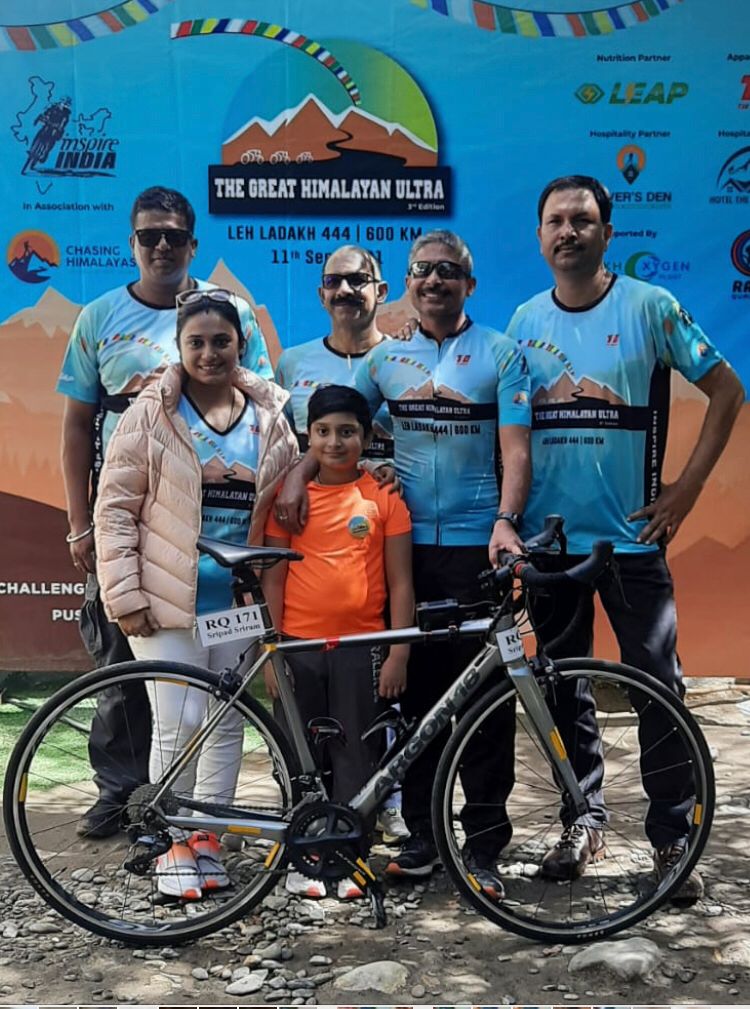


To be honest, this is not how one approaches events like these. We had just thrown a few people into the mix with no prior planning and preparation and just hoped that things would fall into place. They don’t. There were 7 participants in our category with Kabir being the reigning champion of the previous 2 editions of the event. He was at the peak of his riding career and undoubtedly would repeat his past performance. Our aim was to finish the event in RAAM timing, which was 37 hours. We were to turn back at Dras and while reaching Kargil on our way back, there was a mandatory halt of 4 hours before we had to start back from Kargil to Leh. I tried to get as much sleep as possible a day prior to the event but was nervous and restless. 

Great Himalayan Ultra (11 September 2021)


Leh-Nurla (115 km)

The dawn of 11 September welcomed us with a steady drizzle. We lined up at the start point by 5 AM and kicked off one after another at 5.30 AM. We had to ride in the opposite direction till Thiksey Monastery and then turn back again towards Leh and then continue our way to Dras through Kargil. It was fairly cold and the rain didn’t make it any easier. We had a timeline in place but I told my crew that it was flexible and not to adhere too much to those timelines. By the time we crossed Leh after turning back from Thiksey, 4 riders had already crossed me. The going was tough but I was confident of catching up. The climb to Gurudwara Pathar Sahib is tough. It is continuous and the worst part is that it seems like a flat and yet one has to labour hard at high cadence and low speeds. From Pathar Sahib, the route rolls down to Nimmu and I flew on that patch. After crossing Nimmu, I halted briefly to change my water-sodden socks which were making my toes numb with the cold. Then the Basgo climb looms ahead after a short respite at Nimmu. I was doing fine and there were no major concerns. But I was definitely not eating enough to fuel me up. Prior to the event, we had discussed what my eating options were and me being a fussy eater, we had a very limited menu to choose from. I thrive on rice and my go-to food is curd rice. But obviously, I couldn’t be on that alone. We were carrying dates, figs, bananas and potato chips to supplement me at timely intervals. Yet, I wasn't eating sufficient amounts. The same was true of my electrolyte intake. I consume Enerzal mixed in water and I wasn't drinking enough. My crew was insisting that I do, but I was brushing them off.


Nurla-Fotu La-Budhkharbu (188 km)

I crossed Nurla in fairly good spirits. Two riders were still behind me and I was enjoying the ride. Around the same place my wife and son crossed me in a vehicle en route to Kargil. At Khaltse, my crew stopped me forcefully to feed me a samosa. I reluctantly consumed it and told them to relax since I could sense that they were tense and serious. I told them that I was completely in rhythm and there was nothing to worry about. I had done this route multiple times so I knew exactly what to expect. I was bracing myself for the impending Lamayuru and Fotu La climbs which were important. We took a short break at the base of the Lamayuru climb to quickly consume a banana and then I took off. It is a stiff and steep climb to Lamayuru and then it eases a bit and then again climbs up to Fotu La top. I took two breaks en route to Fotu La and reached the top by 4 PM. I was slightly behind schedule but nothing that could not be compensated. We rolled down till Haniskot and again climbed till Budhkharbu. At Budhkharbu, we took a break to replenish. I had some dal rice but did not enjoy the food as much. It was cold and it was raining and I was feeling the cold with all the wet clothing. The break at Budhkharbu stretched beyond what we would have hoped for.


Budhkharbu-Kargil (258 km)

Beyond Budhkharbu, I started to tire. My body wasn't getting enough fuel in terms of nutrition and hydration and the energy was getting sapped pretty quickly. We climbed Namik La and then rolled down to Mulbekh, but with frequent halts. We had planned to reach Kargil by 6 PM and I could only reach Namik La top by then. We still believed that we were OK. From Mulbekh also it was a slow ride till Kargil which we finally hit by 8 PM. There was one more rider, Mustafa, who was riding immediately ahead of me and we both started from Kargil towards Dras at around the same time. At Kargil, my wife tried to force-feed me some hot Khichdi, but I consumed very little. My list of mistakes was increasing.


Kargil-Dras (318 km)

We started from Kargil by about 8.30 PM and I thought we would reach Dras control point by 11.30 and how wrong I was. The mistake I made was to underestimate this stretch by a mile. The entire route is a steady climb and at places, steep too. I did not realise this as I had never ever ridden a cycle on this stretch. It wouldn't be an overstatement to say that this passage of the race broke my will to ride. I was tired, fatigue had crept into my limbs and my mind had started to give up. I was taking frequent halts too. I was lagging behind and my crew was losing hope. I’m sure they would have been disappointed with my pace but they did not show it. It was still raining and very cold. I made slow and painful progress. Halfway to Dras, my course mates were waiting for me with fresh curd rice at Thasgam. It lifted my spirits to see them but I couldn't consume much. A few km after Thasgam, I halted and asked AK sir if it was prudent to continue the race. I thought we should think of the Guinness attempt and preserve the body rather than get fatigued so much in this ride that the body doesn't recover in time for the Leh-Manali ride. He was definitely surprised at this thought process and told me not to think and just ride till Dras. I continued reluctantly. Beyond Bhimbat (10 km short of Dras), I was riding only because AK sir kept motivating me (and shouting expletives) to make me ride. I did not want to. The cut-off at Dras was 1.30 AM and I was dangerously close to missing the cut-off. After what seemed like an eternity, we finally made it to the control point at 1.25 AM.

Beyond Dras

We started back after a brief break and Mustafa was just ahead of me. So, all was not yet lost. I was still within cut-off timings but I needed to reach Kargil by 4 AM to still remain in the race. I was riding slowly and my mind was shutting down. Sleep deprivation had set in and there were times when I was dozing off while riding and had to pinch myself, shout out and think of my wife and son waiting at Kargil to keep myself on the saddle. Halfway to Kargil, I was dozing off repeatedly. My crew observed me and asked me to halt and take a power nap in the car. I happily obliged. The warmth of the car as compared to the rain outside further demoralised me. I woke up and started riding again and still kept dozing off while riding. It was getting risky. And because of the slow pace, I was definitely going to miss the Kargil cut-off time. My crew decided that it was enough and pulled me out of the race. I did not once protest. We went back to Thasgam and crashed into the warmth of one of the guest rooms. My crew informed the organisers and my wife about our decision to quit the race and my wife kept insisting that they push me to ride till Kargil where a mandatory 4-hour halt would make good my sleep requirement. But the die was cast. I quit the Himalayan Ultra after riding 340 km in approximately 23 hours!

The Ignominy of Quitting

The next morning was difficult. Quitting is shameful, especially for someone from an Armed Forces background. If I were completely honest with myself, I had lost the will to ride beyond Dras. My mind had given up. I don’t blame my crew. They are required to take decisions during the course of the race and whatever they deem correct shall be followed. It is the crew’s task to decide these things since the rider is not always in the best of his/her mental faculties. But I knew I could have gone till Kargil and my wife knew that too. She was sorely disappointed by the decision to quit. After a 4-hour sleep break at Kargil, probably I could have pushed till Leh. But these are all conjectures now and hindsight is very cruel. The bottom line is that the next morning, we made it back to Leh in our vehicle with a fatigued body and a shattered mind. This was my cross to bear.

The Post-Mortem at Metta Cafe (13 September)

We returned to Leh by the evening of 12 September. The dejected me stayed in for solitude rather than for recovery. My wife attended the award ceremony of the Himalayan Ultra on 13 September where other riders and crew inquired about me. Mustafa, who was just ahead of me at Dras, had completed the ride despite not being in RAAM qualifying time. Kudos to him and all the other riders. Sumit and Kabir expressed the intent to meet up and discuss what went wrong for us. We decided to rendezvous at Metta Cafe along with my crew. There were serious question marks on the future. The Leh-Manali ride was scheduled for 25 Sep which was less than two weeks away. I had lost confidence in myself and I was not very sure if my crew had faith either. Regardless, we decided to sit and analyse the entire ride. So there we were - Ramya, AK Sir, Satish sir, Kedar Joshi, Sumit, Tanvi, Kabir and Jyothi (Kabir’s crew member and Bharat Pannu’s crew chief when he did Leh-Manali the previous year).

The bottom line was that we did not plan our nutrition and hydration properly and that was the reason I could not carry on. My crew was also candid in accepting that they did not have a clue as to what I preferred to eat and drink and also the fact that we managed to assemble at the last minute and therefore the planning was utterly inadequate. We, however, agreed that I should have carried on and completed the ride instead of quitting midway. The general consensus was that I should not attempt the Guinness record this year and wait for the next summer which would give us time to prepare and make a fair attempt. There was also this aspect of road conditions that was highlighted by Sumit and AK sir wherein a 22 km stretch between Brandy Bridge and Sarchu Nala was completely devoid of any tarmac and was under construction by the BRO. That stretch could seriously affect our timings and it was only expected to be repaired by the end of the season. “The Leh-Manali route is not going anywhere. Attempt it next year”, they all said.

But how could I now take a back step? A major part of the Army organisation had already chipped in for 25 Sep 2021. The stage was set and the event was being included as part of ‘Azadi ka Amrit Mahotsav’ and as an event to commemorate 195th Gunners’ Day celebrations. There was too much at stake for me to back down now. I was adamant that I would go ahead whether or not the crew agreed. There were fierce debates, arguments and counter-arguments. My wife supported my decision. We wanted Sumit to join our crew for the Guinness attempt. His inclusion would greatly boost our crew in terms of experience, especially considering that he knew the entire Leh-Manali route like the back of his hand. Kedar Joshi would be leaving and could not come back for the Guinness attempt and we were acutely short of crew members. Sumit understood the situation and predicament and he said he was returning to Mumbai but would come back to Leh and join our crew if I definitely decided to go ahead with the ride. His only condition was that I should first recce the route and satisfy myself that the ride was possible under the current road conditions. Come to think of it, I had not once seen the route on which I was attempting to break a world record! AK Sir and Satish sir agreed to return to crew for me too. But the general feeling among everyone was not very optimistic and they were hoping that I heed their advice and drop the plan for this year.

What did I feel? The thought of not doing the ride did not occur to me at all. Granted that I had quit the Himalayan Ultra but that was primarily because my mind gave up midway. If I had just shown a little more mental fortitude, I could have finished the ride. Yes, the route recce was important and that was a good outcome of this meeting.

On that note ended our iconic Post-Mortem.

The Route Recce

On 17 September, we embarked on the route recce to ascertain the feasibility of attempting the ride and seeing the route first-hand. It would have been plain stupidity to cycle the route without even seeing it once. I’m glad my crew coerced me into doing this exercise even if their intention was to dissuade me from attempting the ride. The road from Leh to Pang was good, barring minor patches. From Pang, the road deteriorated into a gravel track which was narrow and climbed steadily up to Lachung La. From Lachung La to Whiskey Nala was bad with descent all through. The road again climbed to Nakee La and then descended to Sarchu Plains through the famous Gata Loops. This stretch of the road was good too. The worst stretch was after the Gata Loops from the Brandy Bridge to Sarchu Nala. To my horror, I saw that there was no road at all. It was just a stretch of sand and rocks. Even the trusted Maruti Gypsy had to move on 4x4. There was no way a road bike could be ridden on this patch which continued for 22 km. From Sarchu the road was good till Killingsarai and then a very bad patch of 1 km which could not be ridden. The road to Baralacha La was intermittently good and bad where I would have to dismount from my bike and walk in a few locations. The descent from Baralacha La to ZingZing Bar was okay and then it improved till Patseo and then to Darcha and to Rohtang La. The descent from Rohtang to Manali was not great and was strewn with a lot of potholes and road construction activity. By vehicle, we took 16 hours to reach Manali.


We took a day at Manali to explore the surroundings and started back to Leh on 19 September. This time, I was making a note of the major points in the route and doing a mental mapping of the entire ride. I also formulated a rough time plan for my ride with plans to reach specific locations at specific times. Upon reaching Leh, I told my crew that I would be attempting the ride. They accepted my decision and promised to be there. I had a detailed talk with Sumit in which we went over the entire route breaking it into segments and assigning time for each segment till Manali. At the end of the call, we realised that as per our time plan, we were reaching Manali in 35 hours and 30 minutes. The previous record was 35 hours and 32 minutes. I congratulated Sumit on us breaking the record by 2 minutes! His response was that even if we break it by 2 minutes, it is still a new record. Couldn't argue with that logic. Sumit was on board and reaching Leh in the next couple of days.

I called up my crew and told them of my decision to attempt the record and they accepted. I also made it clear that I have not become a better rider overnight (since the Himalayan Ultra) and that we need to plan and prepare well for us to get this done. I said the aim is to break the record and how it is to be executed is for all of us to work out. It was that simple.

The Crew

Since Kedar Joshi was not returning to crew for this ride, we were left with AK sir and Satish sir. Sumit replaced Kedar Joshi but we were still short of crew members because we wanted to use two support vehicles for this ride. One ahead, looking after my nutrition and hydration and one following me behind at all times. I called up Pradeep sir who was posted down South and he promptly agreed to join. Nitin sir also got on board and thus we had 5 crew members plus my wife who was to assist in the nutrition aspects. The entire crew was to assemble at Leh by 22 September to go over all the preparations and to cover finer aspects of planning.

The External Support (And Noise)

I have mentioned earlier too that I received a lot of support from my family, friends, school group, the Army and the cycling community. One has to be fortunate to get so much support as I did. I was lucky to be surrounded by good people who wanted to see me succeed. The Artillery had pitched in and provided financial and moral support. My parent unit was cheering for me and two of my ex COs had joined my crew. My wife was with me in Ladakh from the first week of September and was doing her best to enable me to achieve these aims of mine. I must mention that the cycling community is a wonderful and vibrant group of selfless people who share a common joy of cycling and I am extremely fortunate to have garnered tremendous support from all corners. Where there is support, there is noise too. We have no control over it. The best thing of course is to ignore it but that is easier said than done. I was disturbed and that noise acted as a catalyst to drive me to break the record.

I was no longer thinking of just attempting. I was now focussed on breaking the record. There was a lot at stake, not least the trust that so many people had in me. I told Sumit and Nitin sir that come what may, this record had to be broken, whatever be the costs. The news of me attempting the Guinness record had already been tweeted by Army handles and news channels too so it was no longer a secret and I was already receiving wishes from many people who wanted to see me achieve the landmark.

The Route: Leh-Manali or Manali-Leh?

The Leh to Manali route traverses 5 major passes - Tanglang La (the highest pass en route at 17,500 Ft), Lachung La, Nakee La, Baralacha La and finally the Rohtang La. The same passes have to be tackled when one rides from Manali to Leh (obviously!) and there is a common misconception that Leh to Manali is just rolling down while Manali to Leh is the real climb. Manali to Leh elevation gain is approximately 2000 metres more than Leh to Manali elevation gain but that does not translate into the fact that Leh-Manali is a descent. One still has to climb all these passes either way. And more importantly, Guinness recognises the attempt from Place ‘A’ to ‘B’ as well as from ‘B’ to ‘A’. The previous record was from Leh to Manali and I did exactly that. 

For the benefit of all, I shall describe the route. Leh - Karu - Upshi - Rumtse - Tanglang La - More Plains - Debring - Pang - Lachung La - Whiskey Nala - Nakee La - Gata Loops - Sarchu - Killingsarai - Baralacha La - Patseo - Darcha (Himachal Pradesh) - Jispa - Keylong - Tandi - Sissu - Khoksar - Rohtang La - Marhi - Gulaba - Manali. The total distance covered is 472 km and the total elevation gained is close to 7000 metres. I would like to highlight that Guinness did not permit me to use the Atal Tunnel so I had to go over the Rohtang pass. The previous record by Bharat Pannu was 35:32 and that was what we aimed to better in our attempt.


Can Anyone Create A Guinness Record?

Prior to attempting any Guinness record, one has to apply on their website. It is not guaranteed that approval will be given. I honestly do not know how and why some applications are accepted while others are rejected. During the attempt, Guinness authorities need a set of evidence that needs to be submitted after completion for the validation of the attempt. I will highlight a few as under:

Two prominent witnesses at the start and finish points (certificates).

Witness statements from random people en route.

2 minutes of video footage every hour of the rider cycling with a time stamp.

All halts taken are to be video-recorded and submitted.

Log sheet of the entire ride with location, time and latitude/longitude and altitude.

GPX file of the ride recorded on a cycle computer (Garmin in my case).

Photos of the ride.

News/media articles, if any.

Once the entire set of evidence is submitted to Guinness, it is examined in detail and the attempt is either validated or rejected by them.

Another aspect that Guinness was very particular about was that the rider could use only one bike for the entire race. One wasn’t permitted to change bikes during the ride unless the bike was damaged beyond repair. After my route recce, I wanted to use a mountain bike for the 22 km bad road stretch between Brandy Bridge and Sarchu Nala and I had a discussion with Sumit on this aspect. He said, either we do it by adhering to the Guinness protocols or we abandon the attempt completely. I agreed with him and dropped the mountain bike idea. Which meant that since that particular stretch could not be ridden with a road bike, we had to dismount from the bike and walk. Severe time penalty!

Leh-Manali Ride Plan

So the crew assembled by 22 September and got to work on the ride. The major headache that we faced was my nutrition plan. I promised my crew that I would eat whatever they gave me without fuss (which wasn’t true). Sumit calculated that I needed approximately 300-350 calories per hour to keep me going. This calculation was based on some of my long indoor rides that I had done while in Ladakh and the data taken out from Strava on what my energy consumption was during rides. They asked me my choice of food and we homed in on a few items that were to form part of the nutrition plan. These were - curd rice, dal rice and potato fry rice (as major meals at intervals of 4 hours) and dates, figs, idli, Swiss roll cake and Little Hearts (as hourly intake) to compensate for the 300 calories. I was to drink 700 ml of Enerzal every hour. The crew was divided into two vehicles - ‘A’ and ‘B’ as under:

Vehicle ‘A’ - AK Sir and Nitin sir with the responsibility of providing me my food and hydration at prescribed intervals while moving ahead of me and also entrusted with the responsibility of evidence collection throughout the route. 

Vehicle ‘B’ - Pradeep sir, Satish sir and Sumit with the responsibility to follow me at all times and look after the mechanical issues and other minor things. They also suffered my choice of songs blaring out from the vehicle all along the route!

Important Ground Rules Certain rules that were not to be compromised were - Firstly, no power naps at all. Not one minute, not 10 minutes. I was only to sleep after I finished my ride at Manali. And the second one was to never stand near a heat source like Kero heater or Bukhari even if we took breaks en route. This was to avoid the body getting into a cosy state and into slumber, especially when the temperatures were sub-zero.


23 & 24 September

While my crew worked overtime to get everything in order, I was required to rest, eat and hydrate adequately. It was not very easy as I am not accustomed to uninterrupted and long sleep and there were times when I had to be forced to go to bed or to eat. We had initially planned for a 6 AM start from Leh on the 25th of September but considering the dynamics of high-altitude terrain where weather changes dramatically after midday, we changed it to a 4 AM start so that we would cross Tanglang La by 12 PM, if not earlier. My brigade commander was flagging off the ride and elaborate preparations were made at the start point (Leh Gate) including media presence. I slept fitfully.


25 September

I woke up at 1 AM to freshen up and get ready. Leh was an hour’s ride from my location and we had to start for Leh by 2.30 AM at the latest. We reached the start point by 3.30 AM. My wife surprised me by carrying out a covert religious act to ‘cast off evil eyes’! I had to answer a few questions from the media people who had come to cover the event. We did a few last-minute checks on our bike and then there was a formal Aarti by the unit Pandit ji after the arrival of the Commander and we were ready to GO. We were flagged off amid huge cheers and I started my ride at 04:00:11 (Hours:Minutes:Seconds).


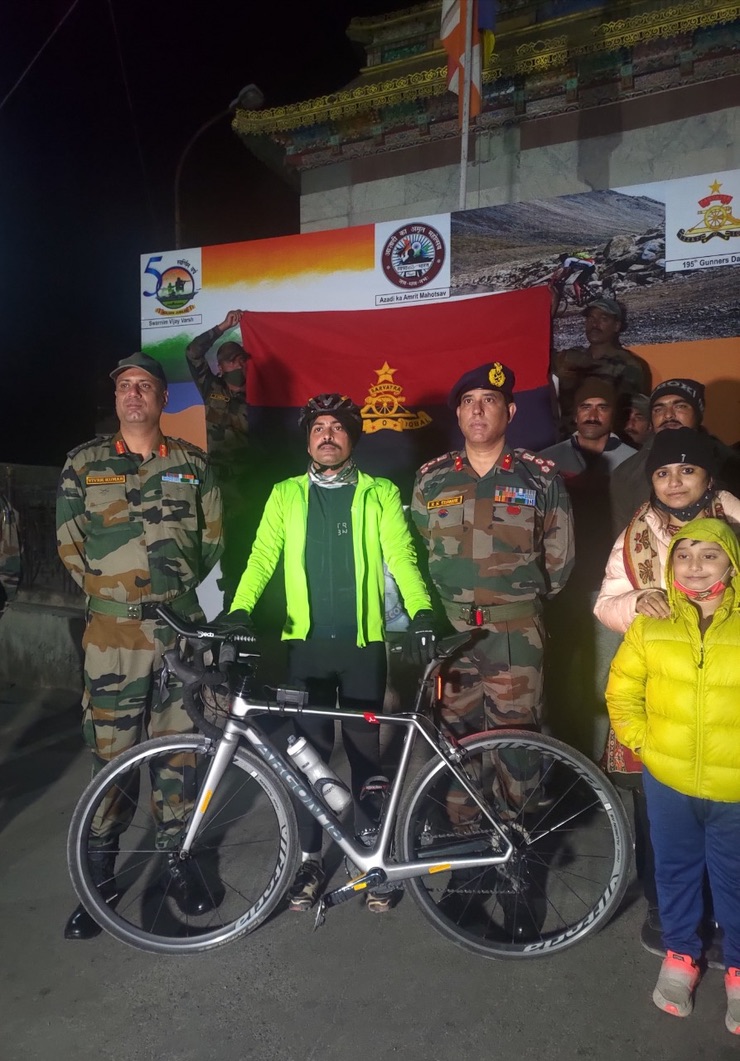


Leh-Upshi (47 Km/06:00:00/25 Sep)

As it generally happens, the butterflies in the stomach prior to the start of an event quickly gave way to a sense of liberation. The wait was over and we were in the business end of the record attempt. It is very important to remember why one is riding and that is for the joy of it. The down slope till Choglamsar helps in getting into a smooth and easy rhythm too. It was a slight drizzle in the morning air but not too cold and definitely not heavy. I reminded myself that I needed to eat and drink without fuss. A lot depended on this aspect and I was sure my crew would not take it too well if I floundered. Again. Our start was steady and we were not rushing; it was a long haul, not a sprint. We crossed Upshi at exactly 6 AM and as per our timelines.

Upshi-Rumtse (80 Km/09:00:00/25 Sep)

From Upshi, it is a gradual and steady climb all the way to Tanglang La. One cannot hope to ride at a quick pace because the climbs require you to keep changing the gears. The road is narrow too. The sun had broken out of the clouds and it had stopped raining. We were on track with our nutrition and hydration. Vehicle ‘A’ was carrying out its task with absolute discipline and Vehicle ‘B’ followed me blaring out my choice of songs. There was fresh snowfall at Rumtse and the overall ambience was positive. Sumit had told me to not think too much and I was just trying to take in the beautiful surroundings and pedal. We took a very short break to put on an extra layer of clothing as it was getting colder and I interacted with my crew who were in great spirits too.


Rumtse-Tanglang La (109 Km/12:26:00/25 Sep)

After crossing Rumtse, we could see the snow-covered Tanglang La ridge. Fresh snow has a different feel to it. The sun was out in all its glory even if the riding had become difficult due to the climb. I had cycled this route earlier which helped because I could pace myself. Pushing too hard on these climbs is not recommended because it can result in cramping up and suffering throughout. In between, my crew members were running alongside me shouting out words of encouragement. After reaching the base of Tanglang La, the climb gets steeper and the going gets slower. I took a couple of breaks in between to stretch out and give some respite to my limbs, but the breaks were very very short. We finally reached Tanglang La top by 12:26 which was behind our stated schedule. Tanglang La is the highest point of this entire route and the first of the 5 passes that need to be crossed and is at 17,500 feet. It was to be summited by 12 PM and after a break for a solid meal, we were to start again by 12:15. I could hear some members mentioning that we were behind schedule but I very firmly told them not to think about it as we had segments where we could compensate. I felt my head begin to ache (I have a migraine problem) and so I took a pill and Pradeep sir gave me a quick head massage.


Tanglang La-Pang (179 Km/15:30:00/25 Sep)

We resumed from Tanglang La at 12:40 after a good break and diet, feeling rejuvenated. The route till More Plains is a complete descent and I was flying down that road. The only issue being the number of potholes that littered the road which required me to check my speed, swerve and slow down repeatedly. After 35 km of descent, the road then rolls up and down till a few km short of Pang and again descends steeply into Pang. This stretch of More Plains is pure bliss in terms of the landscape and natural beauty. We crossed several motorcyclists who do this road biking as a revered trip to Ladakh. Very many of them encouraged us by raising their arms in a thumbs-up gesture. The descent into Pang was exhilarating. I felt in great spirits and shape and there was no sign of any fatigue - physical or mental. We crossed Pang by 1530 and took a short break to loosen up the limbs. We were 30 minutes behind schedule.


Pang-Lachung La-Whiskey Nala (203 Km/18:16:00/25 Sep)

After Pang, the road deteriorates and is more of a gravel patch than a tarmac. This obviously impacts a rider’s speeds as a road bike gets impacted by these kinds of surfaces. To add to that, the narrow road also poses a problem because of the traffic that plies on this route which includes trucks too. The road also climbs all the way up to Lachung La which is the second of the 5 passes en route. I started to feel tired on the climb and took my time to slowly make the ascent. It was great to see my crew members atop Lachung La cheering me up as I approached the top. Lachung La stands at an altitude of 16,600 feet. We did not halt there and continued on the descent to Whiskey Nala. It is a steep descent but the gravel road is in bad shape. There were potholes, loose stones and sandy patches that needed to be avoided and I did not have the luxury of rolling down at high speeds. The jerks that the body was subjected to because of these road conditions were making my limbs very painful and my arms quite numb. I was praying for no more descents because of this painful experience. We reached Whiskey Nala at 1816 hours just as the sun bid adieu to us. We were about 45 minutes behind schedule.

Whiskey Nala-Nakee La-Gata Loops-Brandy Bridge (227 Km/20:00:00/25 Sep)

We took a short halt at Whiskey Nala to recharge ourselves. I had an omelette at the cosy and homely Dhaba and we did a quick change of socks and I put on some extra layers. We resumed from Whiskey Nala at 1835 hours and started climbing to Nakee La. The roads were terrible and the going was very laborious. I was relying heavily on the headlights of my follow-on vehicle because of the darkness and also due to the traffic from the opposite direction. Safety was important and I prioritised it over speed. I was prepared for this slowing down on this stretch. After climbing Nakee La which is at an altitude of 15,550 feet, we continued straight through the Gata Loops without halting. By now it was pitch dark and the blind turns of Gata Loops were not easy to navigate. There was one instance when I almost went off the road towards the valley and at the last minute steered towards the road. Phew! Finally we descended the Gata Loops and headed towards the Brandy Bridge which is the commencement of the Sarchu plains. We had almost traversed half our route in approximately 16 hours!


Brandy Bridge-Sarchu (254 Km/22:31:00/25 Sep)

The most harrowing of the road stretches began after we crossed the Brandy Bridge. I had recced this route and we knew what to expect. This was the stretch where I had wanted to use a mountain bike but could not violate the Guinness protocols. This was a 22 km non-existent road stretch. I had to dismount and walk for the better part of this road. My crew were moving ahead to ascertain if there was any road patch that I could ride and there were few and far between. We were crossing small rivulets, stone dumps and loose sand in this entire route. Not only did this severely impact our time-plans but it also affected the psyche of the rider and crew. But my crew did their best to lift up my spirits by talking constantly, pepping me up and cheering throughout. After what seemed like an eternity, we finally reached Sarchu Nala which was the end of this terrible patch. We could see the lights glowing in the distant Sarchu, yet it seemed so far to me. We finally reached Sarchu at 22:31 hours. I was supposed to take a halt here and put on additional layers and have a solid meal before embarking on the climb to Baralacha La. The temperature was hovering around minus 8.


Sarchu Halt

At Sarchu, before I could do any of the other things, I had to attend to the call of nature. I then put on additional layers including changing the base layers since it had already been more than 18 hours of riding since Leh. I then had to swallow down food which my crew served up. All these took more time than we anticipated and it turned out to be a longer break than we had planned and anticipated. By the time we were ready to resume our ride from Sarchu, it was 23:15 hours. I was frustrated because of the long halt and in my own mind, we were 2 hours behind schedule. I did not tell the crew but I was losing hope of breaking the record. However, I had no doubts that I would finish the route. Quitting the Himalayan Ultra was bad enough without adding this to the list too. My crew was upbeat. Sumit especially seemed in good spirits and he said we were 15 minutes ahead of schedule. I thought he was just trying to boost me up.

Sarchu-Baralacha La (284 Km/02:45:00/26 Sep)

Baralacha La was a 30 km climb from the Sarchu plains. It is the 4th of the five passes and stands at an altitude of 15,900 feet. As we resumed our ride from Sarchu, I could feel the cold and the winds. My hands were getting numb and the wind was adding to the chill factor. To top it all, I started feeling sleepy. I was dozing on my bike while riding. My crew saw me and were honking repeatedly to jolt me out of the sleep. After observing me for a while, they stopped me and poured water on my head in addition to giving me a few coffee shots to get me back into riding shape. I could feel the ghosts of the Himalayan Ultra return and resolved to fight off the urge to lie down. It was close to midnight and the body was feeling the fatigue and the sleep deprivation. It was better after this intervention by the crew. I rode steadily till Killingsarai where we had to dismount and walk for a kilometre because of the bad roads. The climb gets steeper from there. It was past midnight and an eerie sense of calm had descended over the night air. 

En route to Baralacha La top, we had to dismount at a number of places because of bad roads. I remember having a conversation with Nitin sir during one of those bad patches where he was walking alongside me and we were discussing my first ever 200 km brevet in 2019. We were posted together in Bikaner and I had come back after quitting the ride at 90 km. I told him then that this quitting business was very shameful and I would complete my SR someday. Going down memory lane made me forget the pain and sleep. I get goosebumps even now when I recollect that moment. We finally made it to Baralacha La top at 02:45.


Baralacha La-ZingZing Bar-Patseo (311 Km/04:15:00/26 Sep)

The descent from Baralacha La was again typical - filled with potholes which prevented a steady high speed. But crossing Baralacha La was like a boost to the sagging spirits. We only had to worry about Rohtang pass after this. It is funny how we fool ourselves to make it sound better and easier. And ultra rides are all about fooling your mind! While descending Baralacha La, I could see the tail lights of my crew vehicle ahead and the headlights of my vehicle behind and there was this stretch of monotonous riding where I could hear the songs playing behind me as I rode down. Sleep deprivation had got hold of me and I had started to hallucinate. I was wondering where the other riders were and why I was riding alone. It took a long time for me to realise that I was the only rider!

We again had to dismount and walk after crossing ZingZing Bar because of bad roads. Then the roads got much better and we made good time till Patseo. We reached Patseo by 04:15 where we had a 15-minute tea break. I was very upbeat here. I was telling Sumit that we were doing OK since Darcha was just 30 minutes away. He didn't say anything and just nodded his head.


Patseo-Darcha (329 Km/05:25:00/26 Sep)

We resumed from Patseo at 0430 hours and I thought good roads and downhills would lead us to Darcha by 5 AM. I was in for a rude shock as we faced horrendous roads and climbs en route to Darcha. Frustration got to me along with the tiredness as each pedal stroke became more and more painful. I had started to feel sleepy again and was trying my best to ward it off. I must definitely have dozed off on the bike multiple times without my crew noticing which was dangerous. We finally reached Darcha at 05:25 hours. At the Darcha check post, we halted for a short break. The sun was breaking through on what was a Sunday morning. We had covered 329 km in about 25 hours. Ideally, I wanted to be at Darcha by 4 AM, so I was an hour and a half behind schedule, but the morning air had a positivity to it. I felt fresh and rejuvenated. Sumit said we had 140 km to cover in about 10 hours. He told me to take it as a Sunday morning ride forgetting that we had been riding for the past 25 hours. And that worked wonders. Looking at a fresh rider, my crew was also upbeat. That was the time I told myself that the record was getting broken!


Darcha-Tandi (371 Km/08:00:00/26 Sep)

We rode at a decent pace from Darcha onwards. The roads were intermittently good and bad but definitely not deal-breakers. The route was also rolling with a good amount of climbs, flats and a few descents. The weather had become pleasant and I had to shed off a layer or two because the cold had reduced too. We crossed the Tandi bridge and had planned for a short breakfast break at Tandi. We reached Tandi at 8 AM sharp and took a halt of 15 minutes to get a change of clothing and a quick bite.


Tandi-Khoksar (401 Km/10:17:00/26 Sep)

We resumed from Tandi at 0815 hours in great spirits. I was hoping to reach Khoksar (base of Rohtang La) by 0930 hours. It was about 30 km from Tandi and in my mind, it was all downhill. How wrong was I? Once we resumed, I realised that it was a lot of steep climbing and that really hit me hard. This happened because I had only seen this route once and that too in a vehicle. My pace really went down drastically. I was losing hope by the minute. After a while, there were long descents too. After crossing Sissu, Vehicle ‘B’ pulled alongside me and Sumit asked me to attack the descents more aggressively. He had refrained from giving any suggestions to me till now and I could sense that he too was feeling the heat and we were really moving very slowly.

I conserved myself on the climbs by making sure to not cramp up and I really put my bike through its paces while going downhill. We finally reached Khoksar at 10:17 and ahead loomed the mighty Rohtang La.


Khoksar-Rohtang La (422 Km/12:50:00/26 Sep)

We took a 5-minute break at Khoksar before embarking on the Rohtang climb. It was a 21 km climb and Sumit asked me to cover it in 3 hours. My usual time for climbs is approximately 9 km in one hour but since I was tired, I was thinking of 8.5 km in one hour and I said I would reach the top in 2.5 hours. He again said 3 hours is fine. And we started. Here, Sumit shifted to Vehicle ‘A’ and they were driving ahead of me. Prior to the event, I had managed to get hold of the Hunter Squadron Flag (my squadron in NDA) because I wanted to pose with the flag on successful completion of the ride. Unknown to me, Sumit had taken the flag out and was keeping it handy because he felt that on the Rohtang climb, there would be a requirement of pushing me to ride and they could do that by holding me to ransom with my ‘Hunter’ spirit.

But there was a surprising sense of determination while I was climbing Rohtang. It was the last of the climbs and I had already endured 30 hours of riding without sleep. I was feeling OK, if not great in terms of the fatigue. There was no hint of sleep and I trusted my climbing abilities to take me to the top before 1 PM. There were terrible headwinds en route to the climb. We took two very short breaks to fuel me up and my crew was constantly cheering me up by encouraging words.

The need to take out the Hunter flag did not arise as we made it to Rohtang top by 12:50 PM - exactly 2.5 hours as I had envisaged. There was a great sense of relief among all of us. It was quite cold at the top and someone quickly got me a wind-cheater to protect me from the cold winds. The end was in sight!


Rohtang La-Manali (472 Km/14:54:48/26 Sep)

As we resumed from Rohtang top, the question was not whether the record would be broken, but by what time margin it would be broken. I was thinking of making it to Manali by 14:30 which would give us an hour’s lead over the existing record. It was all downslope to Manali but the road was under repair in many parts and potholes were abundant. I had to dismount multiple times in this descent too. There was a patch which was so bad that I almost fell off my bike in trying to negotiate it and I told myself to take it easy and not injure myself when we were so close to the end point.


I had started to feel a fever build up and the body start aching up. But it didn't matter. We crossed Marhi and Gulaba and entered Palchan which was the entry to Manali. We crossed some traffic in the markets en route. Finally, at 14:54 hours, we reached the end point near the Manali bridge where there was a smattering of Army, Police, Civil administration and local media to welcome us as we finished this epic ride.


Relief, rather than euphoria, is what I felt as we completed the ride. We were received by the SDM and the DSP at the finish point. I was quickly taken aside for a media interview and then we clicked the mandatory photos with the crew and all others who had assembled. By then, I was feeling very feverish and all I wanted to do was to take a quick shower and go to sleep. After some time, we made our way to the Palchan transit camp for a well-deserved rest and recuperation.

I happened to be at the right place at the right time with the right people and the Guinness record for Fastest Cycling (Men Solo) from Leh to Manali had been broken by 38 minutes! 


Post Leh-Manali

There wasn't much time to party at Manali since we were all quite tired. Pradeep sir and Satish sir had to move back so they got a bus to Delhi the same night. AK sir, Nitin sir and Sumit did have a good time in high ‘spirits’ while I was in a deep slumber. The next morning, we freshened up and started back to Leh. That was a memorable ride as we relived the entire route and what each of us felt during different times of the ride. We reached late night and we did party into the early hours of the morning. Each of us had to move immediately for our respective work-related issues soon thereafter.

Acknowledgements

Without my crew, I could not have achieved this feat. They were the difference between quitting at the Himalayan Ultra and finishing at Leh-Manali. They were an extremely spirited, dedicated and selfless bunch of individuals who did not know each other before this event. Getting together like that, planning everything for the ride and then making me complete the ride is no mean achievement. Every member had a separate role - AK sir was solely focussed on my well-being and safety, nothing else mattered to him. Satish sir was the experienced voice, Pradeep sir was the breath of positivity who remained cheerful all through. Nitin sir was the live wire, cheering, running alongside and boosting me up and Sumit was the strategist, forever thinking, calm, composed and the heart of the crew. I will forever remain indebted to this fantastic group. Without Ramya, my wife, I probably would not even have attempted to undertake this ride. From the time I picked up cycling in late 2018, she has always been the strongest pillar of support. I cannot begin to imagine how many sacrifices she has had to make for me to follow my passion. My son, Dhruv, was no less important in this entire scheme of things.

When I needed it most, the Army, as an organisation, rallied behind me and provided support. My schoolmates (Saikorians) were with me in spirit all through the ride. It was overwhelming to see them follow each moment of my ride when I later saw it in our WhatsApp groups. Senior officers of the Artillery had shown tremendous faith in my ability to achieve this record and with that, I gained in confidence too. My family and friends never for a moment felt that I would come back without achieving it. Thank you to all of you. For once, I’m short of words to convey my gratitude.

Work-Life Balance

Does this need to be elaborated? We all are, mostly, working individuals in varied fields. I do not suppose that any organisation spares someone to only follow his/her passion while sacrificing work. We need to juggle between the two. There will be times when one takes priority over the other but that balance needs to be maintained without expecting a lot. It is difficult to discover a passion or to realise what you are good at. Once you do, it would be foolish to not pursue it. It is, after all, one life.


Guinness Certificate & Validation

Despite my crew pushing me to submit the evidence to Guinness as soon as possible, I delayed. Sometimes because of my work commitments and at other times because of my callous attitude. We submitted the evidence quite late and the validation also got delayed. We finally received the certificate in December 2021.


I hope you enjoyed this ride as much as we did. I end this piece with a famous adage from the National Defence Academy (NDA) - 'It's All Mental'. Cheers!


Sunday, 17 October 2021

Weak To 'Weaker'

Weak To Weaker


A week after setting foot in the cool confines of Wellington, I found myself with ten colleagues in the syndicate room, waiting to dazzle the Directing Staff (DS), the colonels who instruct us, with our performance in the IKT (Initial Knowledge Test). I had reached the Staff College the way most of us do, having survived a brutal entrance examination, and I carried the quiet certainty of a man who has been told, repeatedly and by competent authority, that he is the cream of the army. An initial knowledge test held no terror for cream. The DS, sensing perhaps that the cream was a shade over-confident, tried to settle our nerves by telling us not to take the IKT too seriously. It was a formality, nothing more. After all, we were the cream. Aren’t we?

At the appointed minute, H-hour for the cream, I began my attempt. I skipped the first page, which was mostly facts and figures; I had never been able to retain the width of a VSL or the span of a BLT, and saw no reason to start now. The later sections, I was certain, were mine. What followed instead was a long column of questions about which I knew nothing whatever. MES, station matters, the doings of other arms, and on it went. Before panic could establish a foothold, I recalled the DS and his counsel of calm. I relaxed, and ticked an answer against every question with the serene impartiality of a man who has no preference because he has no idea. I laid down my pen in a flat twenty minutes. Surveying the room, I found ten faces bent low over their papers, ticking and crossing and ticking again, and I wondered why grown officers were getting so ‘senti’ over something as trifling as the IKT. I sat back. Not idle, exactly, for there were chores to plan: recharging the Tata Sky, getting my wedding suit altered to ‘staff college standard’, the small administration of a man with time on his hands.

My reverie was cut short by the DS, who came to relieve me of my sheet and read it over. I watched, smug, as he settled into his chair. After a while he looked up and smiled at me. I returned the smile and began totting up the brownie points I had banked before we had so much as exchanged names. He asked, mildly, whether I would like to carry on. I said I would, in the affirmative. I packed up my briefcase, the brand-new ‘DSSC’ issue that marked me unmistakably as cream, took a last look round the room of strugglers, and walked out. The thirty-minute head start I put to good use, reaching the CSD well ahead of the pack and ransacking it at leisure. Chores done, I went home to a homely lunch and a thoroughly deserved siesta.

The IKT passed from memory into the general blur of the course. Then one morning, over a black coffee at Chanakya, I overheard the phrase ‘weak list’. I drifted across to investigate. A coursemate sat grieving; the college, it emerged, had taken the IKT scores and used them to sort a few unfortunates into a weak student list, an official register of the academically infirm. I offered the man my condolences. I may also have admonished him, gently, for stumbling at a hurdle as low as the IKT. One must, I felt, keep up standards. He took it well, all things considered.

A couple of quiet days followed. I was deep in the luxury of still being asleep at nine on a Saturday when the phone began to ring. I did the only sensible thing and ignored it. It rang on, with the persistence of bad news. At length I answered, to find my ‘weak’ coursemate on the line, instructing me to present myself at the syndicate room at once. I made him say it twice, and then a third time, before I could bring myself to accept that the message was meant for me. He rang off, but not before mentioning, with what I detected as some satisfaction, that the DS was waiting with open arms.

I do not recall the journey. For all I know I set a Staff College record from Gurkha Hill to Delta Division parking, the swiftest reluctant march in its history. The welcome on arrival was warm. The DS received me into the weak gang and proceeded to a thorough appreciation of my past ‘fauzi’ performance, my IKT, and our collective distinction as the unwanted cream of the 73rd Staff Course. The cream, it appeared, had curdled.

What the weak classes actually consisted of I shall carry to my grave with the dignity it deserves. I will say only that there is a particular flavour of humiliation reserved for a roomful of decorated field officers being walked, slowly and with great patience, through a thing a recruit learns in his first week. Our DS, a colonel of the old school, had a habit of removing his spectacles before delivering a verdict, as though the sight of us was best taken in soft focus. ‘This,’ he would say, polishing the lenses, ‘is fundamental.’ It always was. We had, between us, commanded men in places that do not appear on tourist maps. On a Saturday morning we could not, it seemed, be trusted with the fundamental.

We were released after two hours and ordered to present ourselves at 0900 each Saturday thereafter. Word travelled, as word does, and across the division we acquired the title of the ‘elite lot’. The following Saturday, ambling up in college formals, I crossed a party of ladies who fell to murmuring as I passed. I caught the words ‘weak classes’ in the murmur. Life went on. I consoled myself with intelligence from the grapevine: a fresh weak list, drawn after the first Revision Assignment (RE-1), would relieve the present incumbents. Liberation lay one examination away.

I resolved to acquit myself well in RE-1. I am pleased to record that I did. My definition of acquitting myself well parted ways, admittedly, with the Training Team’s, but a man must be allowed his own standards. The upshot was that I did not merely keep my place; I graduated, with full honours, to the post of the most experienced member of Weak List-2. The promotion raised a few eyebrows. A colleague or two assumed a clerical error and said so. But the register held firm, and so did I. I had achieved what no other officer of the 73rd course could claim: selection to the weak list twice in succession. From ‘weak’ to ‘weaker’ in the space of a few weeks, and not a soul able to match it.

I now await the results of RE-2. My faith in the system remains total. Let them bring on Weak List-3; I am, after all, its natural candidate, and I would not wish to break a record I have worked so hard to set. Cheers.

Update. This morning I had my counselling with the SI, the Senior Instructor, a Brigadier who heads Delta Division and to whom all the DS, and all of us, ultimately answer. He had news. The weak list, he informed me, has been abolished. The whole apparatus, the register, the Saturday parade, the soft-focus fundamentals, gone, as though it had never existed. No more ignominy. I confess to a small, traitorous pang. I had been the last and the greatest name on a list that no longer exists, undisputed champion of a contest the authorities have quietly resolved never to hold again. There is, I find, no medal for that.

Sripada Sriram

L/No 554

Sunday, 11 April 2021

Letter to Father

          LETTER TO FATHER

Dear Father,

It’s been a long time since I wrote to you. The advent of the mobile phone has stolen the sheen of the good old letter writing. Letters that could pack in themselves some unsaid emotions that words could not so easily convey. I remember fondly that the letters that I wrote to you from school were almost always an experiment for me in dabbling with the English language. I was, of course, discovering the magic in that prose, little aware that reading and understanding the words was difficult for you. That you used to get one of your English-fluent colleagues to decipher the meaning of my words did little to hamper my continued experimentation. One of those many things that I failed to appreciate and understand.

But it is not to reflect upon those letters that I write to you today. I have picked up the pen to share with you my unbounded joy of visiting our home town after a gap and reliving our good old days in the simple environs of a calm and laid-back place like Bilaspur. It won’t be a cliché to say that not much has changed. But the changes that have happened will leave us with a tinge of nostalgia and an acute pain of no longer being a part of the city which, for so long, was our home.

The railway station has undergone a massive transformation. I guess your old office has also shifted. I searched for it, but in vain. I also tried to scout out a few of your colleagues, but I found none. All those trains streaming in reminded me of those old days when I sometimes used to accompany you in the tight confines of the diesel engine and later on the electric ones. I tried to picture you standing inside the engine, looking out for the signal as the locomotive cooed onto the platform. As I trudged along the platform, I saw the same old black-coloured, standard-sized boxes bearing the names of their owners and in that instant, I saw the image of your box in my mind – ‘SJ Pantulu, Driver, Bilaspur Division’.

I then went off to each of the houses that we stayed in. My earliest memories were of the one-room quarter in the old Loco Colony. To my surprise, it was still standing strong. But it seemed so small to me that I wondered how we could have lived there so happily all those years ago. I then went to the house in Wireless Colony. To my surprise, it was in ruins. I was aghast at the sight. The best memories of my childhood were associated with that home. Here was the place where I learnt to play cricket, made my best friends and started understanding our overall situation and was also introduced to the vagaries of life, obstacles, problems and yet how to stay happy and content. The mango trees that we had planted as kids had been uprooted too. I came away from there, a piece of me, left behind at my favourite home.

As I was driving through those narrow roads, I crossed many people cycling away to work and I felt it was you, with your black bag tucked behind on the cycle carrier, pedalling away to work, come sunshine, cold or rain. I so wished you would turn back and smile at me. I also went to the house which I only used to visit as a guest, on my vacations from Sainik School and, later on, NDA. I fondly remembered the kind of excitement you all showed when I was home, preparing the choicest of dishes for me and leaving the TV completely free for me to view to my heart’s content. The taste of the special spicy curry that you used to prepare still lingers in my mouth.

How can I not mention to you the excitement I felt when I passed the vegetable market? We used to go to this place once a week, me, riding piggyback on that Atlas cycle of yours, holding those massive cloth bags to accommodate the truckload of vegetables that we were going to bring home. I still cannot erase my memory of your unadulterated enthusiasm in selecting the vegetables and driving a hard bargain. Vegetable shopping was almost like a religion to you. Can’t we go back to that market one more time and soak in the unbridled joy of such a simple pleasure of life?

And, finally, the day you retired from the Railways. I recall your relief as well as the grief you felt at having to bow out of the life that you had lived for the last 33 years. Your emotional farewell speech, flanked by the juniors that you had mentored, chokes me up too. But I was also happy that years of active work were finally behind you. They gave you a worthy send-off. I could see how much you meant to them all. One would have thought that after retirement, we could spend more time together – as father and son, sharing joys and sorrows in only the manner that a father-son duo could. How did we fall apart? We kept drifting away to an extent where it became impossible to get back.

I wish you were here today. I have so much to tell you. Lots of good stuff to share, some agonies to narrate, places to visit and people to introduce. I wish you were here to see your grandson wreak havoc, throw caution to the winds and make life sweetly miserable for us. I wish you were here to play with him, talk to him, tell him how good I was when I was his age (!) and give him the pleasure of having a granddad by his side. I wish we could go into the forests of Kanha together and unlike the last time when we came back empty-handed, I wish we could sight a Tiger together.

Do you remember our constant debates on the state of Indian cricket? Your disappointment vs my optimism? I wish we could watch matches together. I especially missed your company when the Indian Test Team was defying odds upon odds in scripting a marvellous ‘come from behind’ victory on Australian soil. I wish we could discuss Virat, the way we used to discuss Sachin. How I wish I could gather all my unfulfilled desires and go back in time to sit with you and share it all. Alas, if only we could go back in time.

I wish I could sit across from you and tell you that I realise how much you sacrificed for me, in giving me a decent education and the opportunity to do well in life. I want to acknowledge your efforts and contribution. I want to tell you, at least once, how much I love you. Why I never said it while I still had the chance beats me. I want to say all those things that I left unsaid all these years. I had the chance to say it to you face to face, but I didn’t. Now I feel the urge to say it but you are no longer with me. I wish you could come back one last time and give me a shot at redemption. I wish.

Hindsight is a torturous thing. It tells you that you should have done the things when you still had the chance rather than rue after the deed is done. I know I should have done all these while you were still alive, I know it. But it’s too late. I wish you could forgive my insolence and stay content wherever you are now. I wish all kids would realise that the opportunity to show their love, affection and gratitude to a parent should never be lost. Say it when you still can, or you will rue it after they are gone.

Rest in Peace, dear father. I love you. 


Friday, 4 September 2020

Banyan Tree

 Directiveed Style Of Command

All of 33 years old, CQMH Abdul Hamid, having been inducted into the thick of war with his Paltan – 4 GRENADIERS, just 12 hours ago, was busy dismantling the famed Pakistani Patton tanks with his lone Recoilless Gun-mounted Gypsy. Over a period of just over a day, he destroyed 6 Pattons and sacrificed himself shooting down the Seventh. He was awarded the Param Vir Chakra (posthumously). Of course, we all know this story. But what struck me a few days ago, while recalling this proud son of the soil, was not that he did what he did but the fact that he could do it because he wasn’t looking over his shoulder for a senior to order him to fire each round of his RCL gun. He had complete freedom of action and, coupled with his audacity and courage, the enemy kept fleeing from their tanks in the face of his determined assault. That’s what Directive Style of Command (DSOC) is, isn’t it?

Many years down the line, we continue to use the phrase but have long cast aside its practical usage. From time to time, the phrase is thrown in during the addresses by our senior hierarchy but on the ground, it remains just that –  a fancy phrase. Let us try to delve into the anatomy of DSOC without resorting to any literature already existing on it; just a layman’s understanding of what it actually means.

As I understand it, if a senior gives me a task and tells me that he expects the finished product by a certain time limit and that I should only consult him if I get stuck at any point, it would qualify as a case of  DSOC. The unsaid and unwritten part of the order is that I have complete freedom of action. It means that I won’t be ‘Micro Managed’ by the person giving me the task. It also means that there is faith in my ability to execute the task and among other things, it means that the finished product is acceptable to the senior, irrespective of how it gets its final shape. Too many positives in what I just mentioned. Right? So, what’s the catch?

The catch is that the Senior has to accept what you produce and on top of that, he has to take ownership of your work, irrespective of its quality. And therein lies the biggest ill of DSOC. A senior who is NOT willing to accept possible substandard work, or does not have any tolerance for errors and who gets cold feet about being accountable for the below-par work of his subordinates will not touch the subject of DSOC with a barge pole, let alone practise it. We do have another fancy phrase for this inability and that is called – ‘Zero Error Syndrome’.

We all talk of the benefits of DSOC and the pitfalls of the Zero Error Syndrome but exactly the opposite happens in our day-to-day functioning. Well, at least in most cases.

The main reason for the above is the desire of an individual to be perfect at what he does. Nothing wrong with it, except that there are many things that are to be delegated to subordinates and the desire to be perfect robs the initiative of the subordinates. The intolerance of mistakes leads to micromanagement and leads to extreme lack of trust in the rank and file. A subordinate is reduced to being a robot.

Zero Error Syndrome is anathema to the very idea of Directive Style of Command. That is the absolute truth.

I had a battery commander in Drass when my service was less than 3 years. I was the convoy commander of the Drass-Sonamarg route. Every evening, all the Numbers 1 used to troop into the Battery Commander’s FRP for an update on the day’s activities and the orders for the next day. Instructions from my battery commander to me were to listen to each Number 1 and then pass orders for the next day. Those orders were purely to be my own. He used to be on a listening watch and unless hell was let loose, he wouldn’t interfere in my orders to the battery. He would change an order given by me only if it was dangerous, considering that we were at high altitude. After the Numbers 1 would march out, he would then patiently tell me what I should have ideally done and what I shouldn’t. He gave me the opportunity to see my orders succeed or fail, as the case may be, all at 3 years of service. He could do it because he took ownership of my mistakes and eventually he was answerable to the CO if something were to happen in his battery. Later, he was my CO. How many guys do you see doing that kind of thing in today’s scenario?

It’s well known that nothing grows beneath the Banyan Tree. Today’s hierarchy closely resembles it. By resorting to micromanagement, we are not giving the next generation the opportunity to express themselves or the chance to apply and think ingeniously. We are just content with clipping their wings; feather by feather. Think of the irreparable loss this is causing the organisation.

2/Lt Arun Khetarpal would not be remembered today had his higher hierarchy not given him the freedom of action. The faith of his seniors would have further propelled him into achieving what he eventually did. The German Panzer Divisions would have hit headfirst into the Maginot Line had the initial General Staff plan for the invasion of France been implemented. Instead the tanks blitzed through the seemingly impassable Ardennes because someone reposed faith in an audacious plan conceived by Manstein, rejected by the German General Staff, given a look into by Hitler and then reluctantly refined by the General Staff. We know the result all too well – the best qualitative and quantitative army of the whole of Europe decimated in a matter of five weeks.

An argument heard too often these days is that certain assignments are too important to be left to the judgement of a junior and hence the need to micromanage. If we are so cautious in peacetime activities, when do we provide the chance for the juniors to exercise themselves? Directly during the war? Is it even pragmatic? A definite No. If we expect that a soldier gives his best in times of peril, he must be allowed to make mistakes, learn from the mistakes and apply himself again and again in Peace. And for that, a degree of latitude and the ability to accept errors have to be ingrained. There is no other way. A person who is being micromanaged at each point of his professional life cannot suddenly one day become a free-thinking, mean, war-fighting machine. One has to be given the chance to grow.

The choice, at each stage of rank, is ours alone. A Banyan Tree or someone who nurtures the next line of soldiers….


Ram


Wednesday, 26 August 2020

OF BUDDIES & RELIGION

ARMY CULTURE: OF BUDDIES & RELIGION

 When I was a first termer in NDA (the prestigious National Defence Academy), I overheard two Drill Ustaads speaking to each other about the new Colonel Training of the academy. "Madrassi hai, pata nahi kya kya changes ho jayega training mei", one of them mumbled in a forlorn tone. Being a South Indian myself, I wondered why this particular emphasis on the Officers’ regional base was to be discussed. I soon forgot about it, caught up with the hectic routine of the academy. One day, while being seated in the academy, I saw a smartly turned out Sikh Colonel striding on to the stage to address the cadets. I shot a quick question to my neighbour, "Who's he?" I got a response in return, "Colonel Training". "No way, the Colonel Training is a Madrassi, not a Sikh officer," I said in all my dead-sure and smug tone. "Yes, you fool. He is a Madrassi - he belongs to the Madras Regiment." My smugness made a quick exit and I learned a lesson that day. An officer's religion is that of his men. Period.

In the 18 years since that day, I have seen not one reason to believe otherwise. Religious beliefs in the Army have fierce rooting. Men kill and die on the war cries of Gods and Goddesses. It is what keeps them bonded, glued and motivated. It is what makes them believe that they are being looked after. In this overall scheme of things, a leader's role is nothing less than the link between the deity and the man on the ground. A 'Bihari' may well be a Coorgi from Karnataka and a 'JAT' may be a Mallu from Kerala. It is the Regiment that matters, not the origins. Terms like 'Pahadi', 'Pandit' and 'Tambi' are terms that are used with pride and dignity, not otherwise.

As a young Gun Position Officer, when, for the first time, we were poised for live firing in the Rajasthan Ranges, I stood with all others for the Aarti that is performed before the Guns would start firing. In all the ensuing chants of 'Om Jai Jagadish Hare,' I remained mum, not once uttering a single line of the hymn. After the Aarti ended and the Pandit offered the Prasaad, I again refused to partake of it. Later, when the men dispersed to get ready for the firing, our Second in Command (2ic) got hold of me and questioned me as to why I did not participate in the Aarti wholeheartedly. I told him that I was a non-believer and did not intend taking part in the religious act. He looked at me long and hard, and with all his restraint, he told me that it didn't matter one bit whether I believed or not; it was a parade and I would bloody well sing the bhajan and consume the Prasaad. I mumbled a defiant acceptance but only later realised that it matters whether one participates or not. The man who believes cannot be discouraged by a leader who doesn't. It is a Parade and it is supposed to be done with all sincerity. The 2ic, by the way, was a Christian.

As a Captain with 3 years of service, I was posted in Drass and for a long time, I was the convoy commander between Drass and Sonamarg. Those who have negotiated the Zoji La would recollect the prominent  Captain's Mor where Captain HC Vadera of the MADRAS Sappers gave up his life during a road-widening work in 1954. The Captain's Memorial is a permanent pit stop for every vehicle that crosses the Pass. It is considered an ill omen if one passes the point without paying obeisance. It didn't matter if I believed or not. As the Convoy Commander, I had to believe; there was no choice. There are similar cases of Harbhajan Baba and many more in every nook and corner of the country. These are the things that matter to the simple military man/woman. One cannot ignore these in the larger interest.

For a large part of my unit life, my buddy (the soldier assigned to assist an officer) was a guy called Mohammad Jabir, fondly called Javed at home. He was fiercely religious and followed all religious procedures diligently. He was a young recruit and had certain inhibitions in being a 'buddy'. I did not ask him to do anything that he wasn't comfortable doing. In a short time, we developed a unique bond which was based on mutual respect. He used to do tasks for me out of his interest without any external prodding. Not only that, but he was also a good professional soldier who knew his tasks on the Gun well and took a keen interest in Unit activities in addition to being a fantastic Boxer and sportsman. Every day with Javed was a lesson. He was a storehouse of knowledge. My Father coined the term ‘Hanuman’ for him. He was like that. No task was impossible and nothing was less than 100%. He was part of the family. Need I mention that not once did it occur to us that as per the social norms, we were at two extreme ends of the spectrum? A South Indian Brahmin family and a North Indian Muslim. In my experience, there simply is no place for religious biases or prejudices in the Indian Army.

There was an occasion when we were posted in Delhi and were allotted a spanking new flat as accommodation. I was tired of staying in the guestroom and was keen on shifting into the house immediately. My wife was then out of the station and not likely to get back any time sooner. Initially, Javed tried to delay the shifting by giving reasons that the house was being handed over slowly. Thereafter he started giving flimsy reasons amounting to much more delay. When I finally confronted him on what was happening, he gave me a sheepish answer that we were waiting for the auspicious day to shift into the new house! My wife and Javed were in constant discussion on this so-called auspicious time. Eventually, it did happen and he completed the ritual by boiling milk in a new pot until it boiled over the sides to symbolise an abundance of prosperity and food to bless the new home as per the Hindu rituals. Only then was I allowed to set foot in the house!

Javed was with me through thick and thin. He was there when I picked up my little one in my arms; he was there when we had a marriage in the family. He was also there when we picked up the mortal remains of my Father and lit the funeral pyre when I was down and out. Religion cannot superimpose itself on humanity or the soldierly bonhomie.

The most common sights that one would encounter in Fauzi religious ceremonies would be that of a Sikh/Muslim/Christian  Commanding officer or Subedar major performing the regimental Hawan and Aarti on religious occasions; people of all faiths come together in devotion under a common roof called Sarv Dharm Sthal, singing their hearts out in Aarti or Ardaas. These are not some special sights. These are some of the most common ones which do not even need a second glance, especially since the fabric of the Indian Army is so interwoven with acceptance of all religions and beliefs.


Photo credit - Swapnil

It is very important to follow religious practices and beliefs in the army, simply because a Soldier needs to repose his faith in a Superior Being. It is that belief in the Almighty that assures him that no harm will come his or his Paltan's way. It is that hope which consoles him that even if something were to happen to him, his family will be taken care of. And it is the same belief that gives him confidence of victory in the battlefield, however impossible the odds are. A notable dialogue of the Protagonist from the Hindi Movie 'PK' goes thus - "Till the time I believed in the existence of God, I had hope of finding my Remote. The day I concluded that there is no God, I lost my hope". 

An officer has a massive responsibility. As was evident in my earlier examples, dealing with a multitude of faiths and beliefs is a sensitive and delicate balance that has to be ensured. Years of peaceful coexistence preclude any undesirable situation from erupting but as an officer, this balance must be maintained at all costs. The boat should not be rocked, least of all by an officer himself. I have realised that what works best for every individual is to keep their strong beliefs, or the lack of them, to themselves and not give them air. Each individual has the freedom to practise their religion but, being part of an organisation like the Armed Forces, individuals mustn't let their choices clutter the environment. At no cost should personal preferences come in the way of discharging official responsibilities. If the men under us are different colours and flavours, we are the Thali. And on that note, Heave Ho!


Tuesday, 31 March 2020

Few Precious Eggs, A Million Reluctant Sperms & A Medical Miracle!


Few Precious Eggs, A Million Reluctant Sperms & A Medical Miracle!

Brief Note to the Readers

If the mention of ‘ovaries’, ‘menstrual cycle’, ‘egg’, ‘semen’ and ‘fertilisation’ make you cringe, read no further. Thanks for opening up this blog and checking us out. Have a good day, sir/madam. If, on the other hand, you are curious and want to read on, dispassionately, please be our guest.

This is a tribute to the indomitable strength of women, the tenacity of the human spirit, the extreme expertise of our doctors and staff, the unstinted support of the organisation and the triumph of life. This is a personal account and it is as personal as it can get given the circumstances.

This blog does not claim to be a hundred per cent factually correct on the medical aspects. This experience has undergone many years of wear and tear and some or many facts may have slipped out of the now ageing memory. Focus on the emotion, not on the facts. Happy reading!

Prologue

The night was spent in trepidation. The morrow was to bring big news; something that was make or break for both of us. Months of medication were wearing her down and our collective optimism was at its lowest ebb; the only silver lining being the expectation of good news. The doctors and staff at the hospital had exuded confidence that we were on the verge of the momentous moment in our lives. Their optimism was contagious and had rubbed off on us. We promised to return with a truckload of sweets if what we wanted were to come true. Still, on the eve of the D-Day, I was a bundle of nerves.

I got up early and paced the house to calm myself down, now and then checking the clock in the drawing-room. The lab was to open at 9 AM, not any earlier. I gulped down copious amounts of coffee while waiting for the time to speed up and finally left home to collect the reports. The wife was a complete contrast - surprisingly calm and composed compared to my nervous state. I reached the lab and went in after parking my car. The staff were in the process of setting up shop and weren’t expecting anyone to barge in so soon. Looking at my state, the lady at the counter offered to hold other things in abeyance and started looking for our report amidst the bundle of many.

She finally found it and handed it over to me. I went out and sat in my car before opening the report. My palms were sweating profusely and I fumbled a bit before opening the envelope. My eyes darted towards the hCG level - 2 mIU/ml. My heart sank. The report was negative. I felt gutted and broken. After what seemed like an eternity, I put the car into motion and instead of heading home, I made my way to the Unit. I didn’t want to go home with this news. I headed straight into my CO’s office, sank into a chair opposite him and broke down completely.

Two Years Ago

I was posted in a field location: high altitude to be precise. I was in a place where even STD facilities were sparse, let alone mobile network. It was still the early days of 2G in India and the internet was not yet a widespread phenomenon. I cherished the 5 minutes of call that I was entitled to – once in two weeks. It was a great lesson on how to cram all your emotions and news into those 5 minutes. And if the weather played spoilsport, the two weeks could easily get extended to more as the telephone line had a mind of its own. It was against this backdrop that during one of those phone calls, she told me that she had to undergo minor surgery. It was a Laparoscopy to treat her PCOS. OK, so what’s PCOS? Expanding it would give us - Polycystic Ovarian Syndrome. In simple terms, PCOS in women is a major reason for primary infertility. Too much medical jargon? Women with PCOS have a more difficult time conceiving than the others. And by difficult, it could also mean Never. But sitting on that 18,000-foot post, I wasn’t aware of all these finer details. To me, it was just a minor surgery and my wife wanted my moral support from thousands of miles away. I gave it to her – over the telephone. Later I came to know that everything went smoothly and the doctor wanted to meet me whenever I was in town. I said fine and soon forgot about it.

Six months after this incident, I went home on leave. Battered, bruised and fed up with the snow and weather, I wanted to make the best of my time with civilisation. During my leave, we also happened to go to the hospital and meet the doctor. For reasons of anonymity, let's label him Doctor Sierra. He was a genial man with years of experience and expertise in his armoury. After the initial introductions, he told me about IVF (In Vitro Fertilisation) and suggested that we go for it. I laughed the suggestion off. IVF? Us? We were both under 25 years of age (Yes, we married early. Can we just proceed?) and my knowledge of IVF or the more common term - Test Tube Baby, led me to believe that IVF was meant for older couples who were incapable of conceiving. Not for younger couples like us who had many years ahead of us. He explained to me patiently that age has nothing to do with IVF. Either one could conceive naturally or one couldn’t. My wife was in the latter category.

I promised him that we would heed his medical advice and took his leave. I had no intention of keeping my word because I still believed that it was all just an overreaction. I went back to the unit without any further thought to this topic at hand.

Second Opinions & Other Options

About six months after meeting with the doctor, I had an outing to Nasik for three months. Since we had time, we decided to consult a local Gynaecologist who was of high repute. She agreed with the previous findings regarding the PCOS and endorsed the opinion concerning IVF. However, she did suggest that we try out IUI (Intrauterine Insemination), which is a relatively simple procedure with hardly any additional time lost. We also went through a series of tests, which, from then on, would be all too common in the years to come. I still remember the first time I was in the lab to give out my semen sample for the semen analysis test. After handing over the slip to the receptionist, I was sitting in the lounge, waiting for my turn and then I saw these two ladies at the reception giggling away at my expense. After spending an awkward five minutes, I got up and walked away! But yes, better sense prevailed and I got myself tested at another lab. Since then, I've lost count of where and how many times I've got tested. It was just a medical procedure, no more awkwardness!

We underwent two procedures of IUI while at Nasik. Both were failures. What such setbacks do is invest one’s mind with doubts. And out of these doubts arises dejection and heartbreak. Try as hard as one might, the disappointment of not being a parent is quite intense. After a period of marriage, having a child is an extremely important necessity. Without one, the family seems incomplete. We may put up a brave and indifferent face for everyone to see, but deep down, you know it rankles. A lot. I could see the same emotions written all over my wife’s face too. But we acted as if it was just another issue, not wanting to aggravate each other’s already fragile state. It was a different phase of life.

The Peace Location

A few months after the IUI, I was back to a peace location. We were back again in the familiar army environs and the social scenario and hardly bothered about our progeny or the chances of it. It was only after a couple of months that we realised that we needed to go for Plan ‘B’ as our efforts and the results were not too promising. So, one fine Monday morning, we headed to the best facility available to us to seek them out in our bid to become parents. The Floor was jam-packed, with hundreds of hopeful couples who had come from far and wide to place their destinies in this crack team of doctors and staff. The mad rush and the despondent faces were a reality check for us. This was going to be a long-drawn-out and bloody affair. Things were going to get difficult.

Our first appointment with the Chief doctor was anything but ideal. After giving us a perfunctory hearing, he gave us a long list of prescriptions and our first IVF cycle was scheduled after a good 18 months! We were shocked, angered and sad. After procrastinating for so long, I now wanted things to speed up at my will. My callousness was going to bite us hard. In the meantime, she was put on a heavy dose of medication to prepare the body for the procedure. With no further details being divulged, we returned home, uncertain and circumspect about the future.

In the days that followed, the medication was having an impact on the wife. Apart from whatever it was doing inside her body, they made her nauseous and the hormone play was such that she remained edgy and restless. This was an indication that the path ahead wasn’t going to be an easy one. We needed to brace up for a long haul. The biggest impediment was the lack of knowledge on how and what was going to happen and the manner in which the process was to pan out. In today’s age and time, everything that we need to know is available at the swipe of a finger but it was not so at that point in time.

Some time after three months, we were informed by the hospital that the timelines had been preponed and that we could expect our first IVF cycle to be scheduled in the early part of next year. This was great news! We were called in for a review to the hospital and the medication was altered to suit the new timelines. Between then and the beginning of the IVF process, there was a requirement of coming in for regular check-ups to the hospital. Because of the nature of the treatment, there were no fixed dates or days for the check-ups. They were entirely based on a woman’s menstrual cycle and hence one could never know when the visit to the hospital had to happen. This was true for the entire duration of our IVF treatment; we simply didn’t know when our next trip to the hospital would be. It was always on short notice. Since I was posted 200 km from the hospital, we would drive down on the day of the check-up, early in the morning. Reach the destination by about late morning, get through the check-up, grab a bite in the hospital cafeteria and then make our way back home and reach by late evening. All this required the support from my Unit, of which we simply had no dearth.


What is IVF?

Aside from knowing the full form of the word, most of us would hardly be aware of what happens in the procedure. I will break it down for simplicity of understanding. For couples who have difficulty in conceiving naturally, IVF is one of the procedures that can make them parents. In this, eggs from the woman are picked up through a procedure while concurrently collecting the semen from the man and then, under laboratory conditions, the eggs are fertilised by the sperm. The embryo (or embryos) are clinically inserted into the woman’s womb after 48 hours. A beta hCG test done after two weeks of the embryo transfer (ET) can either confirm or negate a pregnancy. In the run-up to the egg pick-up, hormonal injections are given to the woman for producing good-quality eggs. This, in addition to the already heavy medication that she has been under for the past many months. One can understand the huge pressure a lady has to undergo in terms of the changes happening to her body aside from the emotional upheavals. In India, more than one embryo being transferred into the womb is common and legal. In general, a minimum of four embryos are transferred to give a fair shot at a positive outcome. That is also the reason that IVF generally results in multiple births.

The First Attempt

In January of the fresh year, we went in for our first IVF attempt. On Day 2 of the menstrual cycle, we were in the hospital and after the preliminary check-ups, we were given some vials of the LH (Luteinising hormone) to be injected daily for the next 15 days and then we were to land up at the hospital for the rest of the process. We went back with the vials safely preserved in the icebox, mindful that we had entered an important phase in the journey. Back home, we decided to be positive and nail this thing. Since we had collected 10 vials of the injection, we did not bother to administer more after the stock was finished. And that was a grave error which we did not even realise. It was only when we went again to the hospital after the 15 stipulated days that we realised that we had bungled up. Big time. We were admonished by doctors like school kids. They too invest their time, expertise and feelings into the patients and it was a letdown for them too. We had, by our own foolishness, delayed our procedure by a further 30 days. We returned home, to wait on for the next time.

The ‘Actual’ First Attempt

Two months after the fiasco, we went back again. This time, we followed all the instructions diligently, erring on the positive side. Remember that all this time, the wife was continuously on medication and as I mentioned earlier too, the heavy dose of medicine was exacting a heavy toll on her body and her mind. The actual heavy lifting is done by the women in this kind of treatment. Not just this, even in a normal pregnancy, a woman's body undergoes massive transformation and most of it painful. Yet, she labours on unmindful of personal discomfort and agony. A very important part of this process is to stand by each other, providing the succour and emotional support lest one of the partners succumb to the pressure.

It was that time again when we had to pack up and be at the hospital for a few days. Our Egg pick-up was scheduled to happen in a few days and as per protocol, every couple was to reach the location 48 hours before the scheduled time. To understand the timelines, let me just give a tabulated breakdown.

48 hours before egg pick-up - Reach location.

36 hours before pick-up (generally happens at midnight) - hCG is injected to ensure rupture of the follicle which would then release the eggs in approx 36 hours from injecting it.

Egg Pick-up - happens early in the morning after administering anaesthesia during the procedure. The collection of semen happens concurrently.

Approx 48 hours after the Egg pick-up - Embryo transfer (ET). The embryos are transferred to the uterus.

14 Days after the ET - Beta hCG test to determine pregnancy.

So having gone through everything that was to be done, we entered the day of Egg pick-up. Early in the morning, with loads of positive energy flowing through our veins, we reached the place and waited for our turn. On a normal day, about 15-16 couples are scheduled for the egg pick-up. After what seemed like an eternity to me, I watched everyone other than my wife come out after the procedure. I was puzzled but refrained from worrying too much. And then, I was called inside. The doctor explained to me that there was a problem. My wife had suffered OHSS (Ovarian Hyperstimulation Syndrome). In plain layman’s terms, when a woman is given hormonal medication and injections to stimulate healthy growth of eggs during infertility treatment, OHSS is a side effect because the body cannot tolerate the dose and can range from mild to severe. Severe cases require hospitalisation and treatment. Extreme cases may lead to fatality as well.

He told me that she was being shifted to the ward immediately to commence treatment. The eggs had been collected and the process of fertilisation would commence. He told me to meet him after 48 hours when the Embryo transfer of other ladies of this batch would be in progress. With a worried brow and grieving heart, I made my way back to my room since no visitors were allowed for the day. The next day I visited her and the sight of all those intravenous fluids dangling from her bedside made me wonder if all this pain was worth the effort. The amount of abuse her body was taking was immense. I tried to cheer her up but wasn’t very successful as I was dejected too.

On the day of the Embryo transfer, I made my way to the IVF centre and waited for the ET of others to be completed. Finally, I went in to find out what was in store for us. The doctor told me that 4 embryos had been formed out of the process. But since my wife was in this condition, it was not advisable to carry out the transfer and the prudent option was to freeze the embryos and carry out the Embryo transfer after two months. I thanked him and left. We accepted the circumstances and vowed not to fret about it any more. The confidence that we had in our doctor was absolute. He was the best that we could have hoped for and it was only natural to just follow his lead. After a week of hospitalisation, my wife was discharged and we went back home, hoping to return in two months for the final step of the process.

Support

A long and painful process such as the IVF requires tremendous support - emotional, moral, etc. The support from immediate family is the most important part of it. We did not divulge much to my in-laws as they would worry a lot and then it would impact their already fragile health. At that point in time, I did not share much of a rapport with my parents, so we left them out of the loop too. And like many Indian families, we didn’t have the good fortune of large extended families. So, in short, there was hardly any family support. But at a time like that, others stepped in. Friends and of course the members of my unit. What we lacked from our family was more than made up for by my unit. Every officer and lady became our pillars of support. The way that we were treated during that period cannot be expressed in words. It would be a disservice to even try and quantify that kind of effort that were put in by every one of them. My requirement of short, frequent leaves to attend to the hospital and the treatment, the mad cravings for food that my wife had - at each step of our IVF journey, my unit stepped in spectacularly. Our joy and our agony were as much theirs if not more. I never could express our gratitude to them in person but I take this platform to convey my gratitude. This debt can never be repaid. Thank you, everyone.

The First Embryo Transfer

After an agonising wait for two months, we went back to our favourite haunt, for the much-anticipated embryo transfer. On the day of the ET, she went in along with others and I took my position in the waiting lounge for the procedure to finish. Time ticked by as I saw all others come out after their respective procedures. My optimism started wavering with the passage of each minute. Was there another twist in the tale? I fervently hoped not. Before I could dive deep into my apprehensions, I was called in and to my surprise, I saw my wife seated inside the doctor's office too. Without wasting time, the doctor told us that 3 of the four embryos that had been preserved had gone kaput. My heart sank. Only one of ours was still viable but the chances of a positive pregnancy were negligible so that option was out.

The doctor said that there was a way out - an option of picking up three other healthy embryos to be transferred along with one of ours. That was a difficult call to take and our consent was needed to go ahead. We requested time to discuss between ourselves. He left us to allow us space. We went over the issue. Initially my wife was open to the idea but on deliberating, we agreed that it was too momentous a decision to take. Even if it’s a positive pregnancy, we would never know for sure which embryo it had been. Of course, desperate times demand desperate measures. But since the direct implications of refusing this option would mean that my wife had to undergo the entire process again, I let her have the final call. She decided not to go ahead and repeat the process. We conveyed our decision and went home, prepared to keep taking the medication and to come back again in a couple of months to undergo the entire process. Not that we were the first or last ones to undergo IVF but still it hurts a lot. Fate had again dealt us a cruel hand. You can cajole your mind for whatever it’s worth, the pain doesn’t cease to exist.

The Second Attempt

After two months of waiting, we went back. This time, we were much more pragmatic. The medication dose had been reduced because of the side effects suffered last time. This time, during the egg pick-up, I had it in mind that complications of OHSS may resurface. I shouldn’t have worried though, because the doctor had altered and reduced the dosage to prevent such a situation from happening again. We heaved a collective sigh of relief when she emerged out of the room, after successful egg retrieval. We waited patiently for the 48 hours to pass before the embryo transfer.

On the day of the ET, we reached there at the scheduled time and waited for our turn. My wife went in and again did not come out any time soon even as other ladies were leaving after their respective procedures were over. I had a familiar feeling in my gut. Something had gone wrong. I could sense it in my nerves. As if on cue, I was called inside. My wife was there too and in those grim surroundings, the news was conveyed to us. Since the dosage of hormonal medication had been reduced to avoid a relapse of OHSS, the eggs were not of great quality. So only one embryo had been formed. I closed my eyes and felt a sense of déjà vu. But wait, there was more news. Since on the day of egg pick-up, it was felt that egg quality was poor, other healthy eggs were fertilised with my sperm and out of this combination, three healthy embryos had been formed - all category ‘A’.

It took a while to digest this bit of news. We were all silent since we could understand what it meant. There was a 66.66% chance that the baby (if positive) would only contain a part of me and not my wife. Was there any way of negotiating this kind of situation? 

A woman bears all the physical, emotional and mental stress of 9 long months of pregnancy and the postnatal phase after the birth of the child. How would it feel to know that the baby does not contain a part of you but of some strange woman? Not surprisingly, I saw my wife break down. This was one of the most difficult situations of our lives and we had no clue what was to be done. Could we consult anyone? No. Although my mother-in-law was now part of the process having been told by us as to what was happening, there was no way we could let her in on news this fragile. Make no mistake, the support that she had rendered to us was immense but we had to leave everyone out of this.

It seemed life was asking us to prove our desperation to bear a child. There was no other explanation for the kind of decisions that we were expected to make. 

After some thinking, my wife refused the embryo transfer. She was prepared to undergo everything for the third time in succession. The final call could not have been made by me. I could only advise her; I couldn’t feel the pain that she was undergoing, and it would have been grossly unfair to take on the onerous task of taking the decision all by myself. That’s when the doctor stepped in. He tried to reason with us, saying that going ahead with the embryo transfer would be a most prudent decision. We had already seen the side effects of medication on her body and subjecting it again would cause more harm than good. He also made us aware that the previous case of OHSS had been severe and the hospital would not take a chance again. He implored us to take the call. Our consent was required to go ahead. My wife still wouldn’t budge. She was prepared to repeat the process. And that’s when he put his foot down. He made it clear that the life of a patient is important and even if we were to refuse this time, the next time will also be an embryo transfer with my sperm and other healthy eggs. There would be no egg retrieval from my wife - ever!

After that, there was no discussion. We gave our muted approval and the procedure went ahead. 33% me and my wife and 66% me and some strangers. Fate had brought us to this stage. No wonder someone rightly said - ‘Fact is stranger than fiction’. Everyone expressed their optimism that this time we would come back with positive news. Their optimism was pure and unadulterated. We went back with hope.

The Result

The night was spent in trepidation. The morrow was to bring big news; something that was make or break for both of us. Months of medication were wearing her down and our collective optimism was at its lowest ebb. The only silver lining being the expectation of good news. The doctors and staff at the hospital had exuded confidence that we were on the verge of the momentous moment in our lives. Their optimism was contagious and had rubbed off on us. We promised to return with a truckload of sweets if what we wanted were to come true. Still, on the eve of the D-Day, I was a bundle of nerves.

I got up early and paced the house to calm myself down, now and then checking the clock in the drawing-room. The lab was to open at 9 AM, not any earlier. I gulped down copious amounts of coffee while waiting for the time to speed up and finally left home to collect the reports. The wife was a complete contrast - surprisingly calm and composed compared to my nervous state. I reached the lab and went in after parking my car. The staff were in the process of setting up shop and weren’t expecting anyone to barge in so soon. Looking at my state, the lady at the counter offered to hold other things in abeyance and started looking for our report amidst the bundle of many.

She finally found it and handed it over to me. I went out and sat in my car before opening the report. My palms were sweating profusely and I fumbled a bit before opening the envelope. My eyes darted towards the hCG level - 2 mIU/ml. My heart sank. The report was negative. I felt gutted and broken. After what seemed like an eternity, I put the car into motion and instead of heading home, I made my way to the Unit. I didn’t want to go home with this news. I headed straight into my CO’s office, sank into a chair opposite him and broke down completely. My CO, who had stood by our side with me throughout the ordeal, left everything else and took me home. I was an emotional wreck. I didn’t know how to convey the news at home.

The sight of both of us coming home confirmed the worst fears of my wife. But at times like these, I never cease to wonder what the stuff is that women are made of. She was extremely balanced. Even if she was broken by the news, she didn’t show it. In the evening, we discussed options for adoption. Alternatives had to be weighed up; we were losing time and her body could not have taken the abuse of the medicine for long. We spent a sombre evening together and proceeded to the hospital early the next morning.

The Pause

Everyone was shocked at the negative outcome. The thing with frequenting a specific place for so long is that everyone becomes a part of one’s happiness and sorrow. That day, I saw the pain in each of those eyes. The doctor asked us what our plan was. My wife was very clear that she wanted a break. A break from all that burden of expectation, hope, wait and most importantly from the medicines. She wanted a clean break from everything related to IVF and the doctor agreed wholeheartedly. He told us to meet again after 3 months. We went back, free from the shackles imposed by the treatment.

We decided to take a break from work too and went home on a short holiday. There was a family function that coincided with the break and we had the opportunity of letting our hair down and enjoying the moment without having to think of any restrictions. It was a good break - wholesome and fun-filled. Once we were back, we concentrated on anything but the thoughts of treatment. It was as if we had pushed those memories into a distant corner of our minds and that was a welcome change. It meant that we were adapting to the situation and were open to any number of alternatives that may present themselves in due course of time.

After probably a month, during a casual conversation, my wife mentioned to me that her cycle was delayed. I was taken aback. I told her to take a home pregnancy test but she dismissed my advice saying, “Why test when we know it’s not possible?” I didn’t argue much but while on my way back from the office, I got her a pregnancy test kit and asked her to test nevertheless. I soon forgot about it. After a couple of days, I asked her what the outcome of the pregnancy test was, to which she responded by saying that the kit was faulty. I was surprised and asked her how she had reached that outcome. She said the test was positive so since she couldn’t conceive naturally, the only other logical explanation was that the kit was faulty. I was aghast at her reasoning. I went out, got two more test kits and told her to go ahead and check them out.
Both the tests proved positive!

Initial Stages of Pregnancy

We went for a check-up the next day to get the medical confirmation of this unlikely pregnancy. It was indeed positive. The foetus was about 5 weeks old and we still had to wait for a couple of weeks before the heartbeat could be detected and the confirmation would be 100 per cent. We relayed the news to our doctors who joined in our happiness but cautioned that precautions and safety were to be as important as ever for the next 8 months too. So how could a woman who was not supposed to conceive naturally defy the odds and prove the theory wrong? All that infertility treatment had had a huge impact on the body and somehow the body had hit the ‘reset’ button. A crude example would be the way a computer is formatted. After that, it apes a new computer! It is not very uncommon for this to happen and we were more than glad it happened to us.

After the foetal heartbeat was detected at 7 weeks of pregnancy, we were sure that there were no false alarms. At around the same time, we got posted to a new location. Things were happening too swiftly. With a heavy heart, we bid farewell to our Unit. All this while, they were our pillars of strength, pampering us, holding us steady and ensuring that we stayed true on the treacherous path to success. Without this unstinted and selfless support system, we would have strayed a long time back. That, I believe, is the strength of our organisation. It is rock solid in holding each other and supporting no matter how hard it is. And in my life, I saw it all too often. Three cheers for this unbreakable bond of bonhomie.

It is common knowledge that the initial months of pregnancy are a hard time for a lady. Morning sickness and the changes in the body are hard to adapt to and the need for personal attention is acute. We decided that she should shift to her parents to weather the initial months as we were yet to be allotted accommodation in the new station and were dining in the Mess which could quite obviously not cater to everyone’s requirements. We decided that she should be back towards the end of the 7th month and had planned the delivery at the present location.

Plans Go Awry

Plans never go as we like. True? One fine day during the 27th week of pregnancy, she felt abdominal cramps. Because she is not the sort to take anything lightly, she immediately went ahead and consulted a nearby gynaecologist. After checking up, the doctor observed that the Uterus had dilated to 2 centimetres and decided to admit her there and then since she was already in labour. My wife refused to get admitted as Doctor Sierra was the one to take the decision and it was to that hospital that she was to go to. The local doctor suggested medication to delay the labour as a temporary measure but my wife refused the medication. 

In this situation, when her mind was blanking out, she decided to call up Doctor Sierra (remember the Surgeon who carried out laparoscopy and was our first doctor?). Every minute lost could be detrimental. Doctor Sierra asked my wife to reach the hospital immediately and spoke on the telephone with the local doctor too. So, while it was confirmed that she was in labour, my wife along with my mother-in-law, with the help of friendly neighbours, ploughed along to reach the hospital sometime late in the night. 

Enter Doctor Sierra. He was a man who minced no words and he was extremely adept at his work. My wife was admitted immediately and placed in ICU. After giving a mouthful to my mother-in-law for failing to reach the hospital earlier, he went on to the immediate requirement of looking after the patient whose uterus had by then dilated to 3 centimetres. 

In the 27th Week of pregnancy, my wife had gone into premature labour! 

On receiving the news, I requested a schoolmate and a very close senior of mine to go to the hospital and take a look at what was happening. He did so promptly to give me some respite from uncertainty. The next day, I spoke to the doctor on the phone and he advised me to come over to have a chat. I hopped on the next available flight and reached Vizag. I straight away headed to the hospital and was allowed to see my wife. She looked frail yet undaunted. Life was not done testing her yet. The doctor explained to me that at this stage, the baby was yet to develop fully and if she delivered, he/she wouldn't survive. What they were trying, by giving her immediate medical aid, was to delay the delivery. I asked him how long they could delay it. He said, and I quote, “one day at a time till one week and then week by week till at least the 33rd week if not more”.

As a couple, we had complete faith in him and he laid out the scenario in as truthful terms as he could. For the entire duration from then till the delivery, my wife had to remain admitted in the hospital. I stayed on for a few days to give her company. Life in the hospital could be extremely boring but the doctor made all sorts of concessions for us. There were no set visiting hours for us and we could get her food from home. These small concessions mattered a lot in raising her morale. Each member of the hospital staff contributed to her well-being while she was admitted.

I returned to work because I was slated to attend a course which could not be cancelled/postponed. It was an important course for anyone of my seniority but to me, it was only of secondary importance. After joining the course, the first thing I did was to inform my instructor of my predicament and request leave as and when the baby arrived. It could be now, it could be tomorrow and if the good doctor prevailed, it could be a few weeks from then. Fortunately for me, my leave was pre-approved. Humanity is still prevalent!

The Final Moment

My wife delivered on a Friday in the 37th week of her pregnancy. The medical staff had pulled off yet another seemingly daunting task – of delaying the delivery for close to 10 weeks. I flew home in the middle of the course to have a look at my wife and my son. Holding this tiny and fragile boy in my hands felt surreal. It was indeed our son. And most aptly, he looked exactly like her. I didn’t want to shed tears in front of everyone but emotions are not planned; they have a mind of their own. I thanked our doctor. He was a God to us. After spending a couple of days at home, I flew back to finish the remainder of my course.

As the plane took off and flew over the Bay of Bengal, my mind went back to recap the events of the past two years. From a hopeless situation, facing setback after setback and resigning ourselves to the possibility of never having a kid of our own, we had come a long, long way. The way was complete with speed breakers, obstacles and odds. But along the way, we also had people who carried us along. Who helped us remain true to the path. Who, by their selfless help, lifted our spirits whenever they sagged, lent a shoulder to cry on, substituted for our families and shared our joy and sorrow in equal measure. We also had extremely dedicated  and adept medical staff for whom we were more than just patients. People repose their faith in God who is neither seen nor heard. For couples like us, these doctors are our Gods. They can be seen, they can be heard and they have emotions too.

Parting Thoughts

I do not know the numbers, but we have many couples who suffer from problems of infertility and yet do not know the way to go about addressing it. Undergoing IVF is not a stigma. Talking about the treatment and the finer aspects is not embarrassing. For a large part of two years, our daily vocabulary consisted of words such as Fallopian Tubes, Uterus, Ovaries, Sperm count, Eggs, Follicle, Endometrium and suchlike. We have enough facilities in our organisation and a host of new techniques called ‘Assisted Reproductive Technology’ - ART in short. Couples should be encouraged to come out of their shells and seek answers to the problem.


To quote from the movie Jurassic Park - “Life, uh… finds a way!”

Ram