GUINNESS ATTEMPT: PUNCHING ABOVE MY WEIGHT
Note To The Readers
When I attempted (successfully) to break the existing Guinness record for fastest cycling from Leh to Manali, I did not know what would be the result. All I wanted was to attempt it and if nothing more, create a memorable experience with my crew. I say it with conviction that if I could achieve this, anyone with the right intent can do it and it's no exaggeration. In the aftermath of the event, many people wanted to know the experience of the ride including the preparation stage. It has taken me a long time to finally sit down and write it all in this piece. It is my opinion that the Guinness ride should not be seen in isolation because the events that preceded the ride are equally (if not more) important to understand the real significance of the Leh-Manali ride. By means of this write-up, I do not intend to get into a self-glorification mode but since it is a first-person account, I will talk about it from my perspective. This will be as honest an account as can be and it is a testimony to what a human body can achieve if the circumstances and people align themselves in facilitating what is sought with a passionate fervour. A few people will figure repeatedly in my write-up, so a brief about them:
Ramya - My wife
AK Sir - My ex CO and a mentor and Guide
Satish Sir - Veteran Cyclist and a Guru
Pradeep Sir - My ex CO and a Josh box
Nitin Sir - Elite PARA officer and an ultra athlete
Sumit Patil - Ultra Cyclist and a super human being
Kedar Joshi - Extremely spirited Coursemate
Tanvi - Cycling friend and coffee expert. Owns Metta Cafe in Leh.
Kabir - As per me, the best Ultra cyclist in India right now.
Bharat Pannu - A senior and an ultra cyclist with multiple Guinness records under his belt.
A few terminologies which might confuse you from time to time:
RAAM - Race Across America. An annual event and supposedly the toughest cycling race in the world.
RAAM Qualifier - An event that, if completed in time, makes one eligible to participate in RAAM.
Brevet (BRM) - Organised rides of 200/300/400/600/1000/1200 km which are officially logged and recognised.
Super Randonneur (SR) - The title one gets if he/she completes 200, 300, 400 & 600 km in a cycling calendar year, which runs from 1 November to 31 October.
Brevity is not a virtue I possess and honestly it would be an injustice to rush over this entire experience. Each event is linked to another, so stay with me, ride this experience and feel free to share your feedback.
‘Skills are cheap, Passion is priceless’
PROLOGUE
It was a pleasant Sunday morning and I had a certain ‘feel-good’ vibe while cycling to Khardung La. I had earlier attempted to scale Khardung La but had returned from South Pullu. Today I was certain of going the distance. About 3 km short of the top, I had to navigate a kilometre-long sandy and rocky patch and I made a mental note to dismount from my bike while riding down so as to avoid slipping on this tricky stretch. Once on the top, I felt exhilarated. I had cycled 80 kilometres from Karu till here in a decent time and as per my expected timelines. After a quick refilling of water and a mandatory photoshoot, I started on the descent which extended all the way to Choglamsar past Leh. Riding down at speeds in excess of 60 kmph, I felt a cold shiver because of the winds. My palms inside the gloves were getting numb from holding on to the brake lever continuously too. Before I could realise, I was staring ahead at that same sandy patch which I had noticed during my uphill climb and with no reaction time whatsoever, my bike started slipping on the loose sand and stones, and hit pothole after pothole. I lost complete control of my bike and the brake levers seemed to have surrendered too. Upon doing some quick thinking in those frenetic moments, I decided to steer my bike to the left so as to avoid the sheer fall into the valley on the right. As I steered left, huge boulders and the mountain side looked me straight in the eye. I said a quick prayer and braced for the impending impact. I crashed into the boulders and flew off the bike.


Cycling Scene Post ‘Super Randonneur’ Status
I had picked up cycling in the winter of 2018 and completed my SR in September 2019. That journey has been detailed in my previous post (link here - https://ikki377.blogspot.com/2019/10/from-being-noob-to-super-randonneur-my.html). After the SR, I continued participating in brevets in Jaipur and I did really enjoy the vibrant cycling community there. Rides were fun and challenging too. In February 2020, I attempted a 1000 km brevet organised by the Bathinda Randonneurs. That was my first taste of long-distance riding combined with sleep deprivation. The route had good elevation gain and felt challenging to me. I completed the ride in 68 hours but not before succumbing to serious hallucinations and mind-freeze moments in the last 100 km because of an acute paucity of sleep. All in all, a good learning experience.
Then of course we were all hit by COVID and outdoor rides stalled completely. At around the same time, I got posted out of Rajasthan. I had also started thinking about what direction to take after doing the brevets. Was it not the logical step to probably raise the bar and do something more challenging? I mean, brevets are fine. Great to ride in groups and share a sense of camaraderie with a group who share a common love for cycling but they are not too challenging and demanding on the body and the rider’s skill sets. And I got in touch with Lt Col Bharat Pannu who was already a known name in the Indian Ultra cycling scene. He had just participated in the virtual RAAM and got a podium finish which was no mean feat. He also held the Guinness record for fastest cycling from Kashmir to Kanyakumari. I surmised that he could probably give me a little guidance to align me to the ultra cycling field. I spoke to him and he did guide me but of course I was an unknown entity to him and it wasn’t possible for him to really understand what I was capable of and what to suggest.
24 Hours Virtual Time Trial (VTT)
A few days later, he sent me a link to a virtual cycling competition. It was called Virtual Time Trial (VTT) and was being organised on Independence Day by a group who called themselves ‘Irregulars’! Sumit Patil, Hitisha and Tanvi were part of the organising team among others. There were 3 categories - 6, 12 & 24 hours. I registered for the 24-hour category and the requirement was to ride for 24 hours and achieve at least 680 km for anyone to be a finisher. We needed indoor trainers for the event and I managed to get a used trainer just a week prior to the event and somehow did the bare minimum to get acquainted with indoor riding. We were 7 riders in the 24-hour category and I did not know any of them. We started promptly at 6 AM with an aim to ride till 6 AM on the morrow and clock 680 km. We were doing the ride on Zwift and it was a loop of 17 km that had to be repeated. I clocked 611 km and stood 4th. Wasn’t easy, especially managing what and when to eat and drink. To put things into perspective, Mayank clocked 771 km and Kabir clocked 751 km. These were some of the top riders in India. I did feel a sense of accomplishment. My first Ultra ride!

5-Day SR (200, 300, 400 & 600 km in 5 days)
In February 2021, I signed up for a 5-day SR organised by the Jalandhar Randonneurs. Rohit bhai was the organiser and I had done a 400 km brevet earlier with them. The hospitality of Punjab is well known yet I was still awed by their excellent conduct. This 5-day SR was to begin with a 600 km ride which was mostly in the Punjab plains without any major climbs. It was to be followed by a 300 km ride to Baba Balak Nath Temple near Una, Himachal Pradesh and it was a challenging route with good elevation gain. Then came the 400 km ride from Jalandhar through Pathankot, Dharamsala, Kangra, Jwala Ji and Chintpurni back to Jalandhar. This ride really tested us all. Not only was the elevation gain a factor, but the bad roads in Himachal added to our fatigue and toughness quotient. There were 5 of us doing the entire SR series - Kanwar, Grinshina, Ramanpreet, Renu ma’am and myself, and we stuck together for the entire route and managed to complete it just in time. Within a couple of hours of completing this ride, we had to commence our 200 km ride to Chintpurni Temple which again had a lot of climbing! Finally, by about midnight, we finished the ride and there was a lot of jubilation and joy at the culmination which we signed off with a well-deserved party.
The 5-day SR was my first real taste of mountains and this quantum of climbing had never been attempted by me before. It was undoubtedly a tough 1500 km in 5 days and not only did it provide satisfaction but was also a revelation to me that I needed to work on my climbing abilities.
La La Land Ultra
It was May 2021 and I was making plans to participate in a ‘Manali-Turtuk’ bike race called the La La Land Ultra. It was a 700 km race which was required to be completed in 100 hours to be a successful finisher. This was also being organised by ‘Irregulars’ and was the longest Ultra ride in the mountains being organised anywhere in the world. I was discussing some of the finer aspects of preparation with Bharat Pannu sir who had, in the previous year (2020), cycled from Leh to Manali and established a new Guinness record for fastest solo cycling (Men) on that route. As we were conversing, he suggested I attempt to break his record of Leh-Manali. I dismissed the suggestion considering it was just polite talk. But he continued to suggest in our subsequent conversations too. His main reason was that the record would remain among the Indian Army fraternity. In the next few days, he sent me the link to apply for the record through the Guinness website. To humour him, I filled up the online application and promised to think about the attempt seriously (yet I wasn’t serious at all!).
In June, I moved to Ladakh as part of our official commitments and I started thinking about the record attempt. The La La Land Ultra was cancelled because of the COVID third wave and that was a bummer. There was a likelihood of the ‘Great Himalayan Ultra’ happening which was an annual event organised by ‘Inspire India’ and it was a RAAM qualifier event. I was involved in work-related activities for the better part of June and July and it was only on 19 July that I took out my bike for a first ride in the Ladakh terrain. I was doing small rides every day and wanted to acclimatise to the weather and altitude before graduating to longer rides. On 31 July, I received an email from Guinness approving my Leh-Manali attempt. Now I was in a fix. There was no excuse for me to not attempt it now and I told myself to gear up. Time was short as I had tentatively planned to attempt it in the last week of September which gave me around 50 days of preparation time, not counting the interruptions in practice due to work-related issues.
Aug 2021
I steadily increased my riding distances and was also doing a fair amount of climbing. The Great Himalayan Ultra and the Leh-Manali routes both comprised long and steep climbs. Even though I didn’t enjoy climbs, I hardly had any choice in this matter. I was doing 50-75 km daily and 100+ km on Sundays. One Sunday I wanted to do Khardung La and back - a total distance of 160 km from where I was. I turned back from South Pullu (15 km short of Khardung La Top) and could only achieve 125 km. Similarly, on another Sunday I wanted to do Tanglang La and back and again I turned back before summiting the top. However, these rides were preparing me for the long haul ahead. Or so I thought! I also did repeated rides on the Lamayuru climb which is en route to Fotu La (Leh-Kargil route) in preparation for the Great Himalayan Ultra. The Himalayan Ultra was going to be my dress rehearsal for the Guinness record attempt on the Leh-Manali route. And the added bonus would be to be a RAAM qualifier if I completed the Himalayan Ultra in 37 hours.
And then the Khardung La crash happened. It was 22 Aug and I had finally reached Khardung La top. But there was a twist in the tale and I suffered that mighty crash. For a while, I was completely disoriented by the fall. I could sense that the right portion of my body was in bad shape since it had taken the maximum impact. I was bleeding from shoulder to toes and I could feel a few broken ribs as my breathing was causing me pain. My helmet had broken but my head was safe. The bike was damaged a lot too. The shifters and brakes had broken and the wheels were damaged. I took a moment to gather myself and my belongings and made my way to South Pullu for some first aid. I rang up my unit to ask for a vehicle and reached South Pullu with the help of a Good Samaritan in his TATA 460. After a few hours, I reached my unit and got checked up by the Doctor. I had six X-rays taken the following day to check for any broken bones. Fortunately there were none. But it would take a few weeks, if not more, for my body to mend and get back to riding fitness. The Himalayan Ultra was 18 days away and my Leh-Manali attempt was roughly 4 weeks away. My plans had been thrown off course.
Post The Crash
I took the next few days off to recuperate. In any case, I did not have a bike to practise on. I began looking for options to get a replacement bike. I reckoned that rather than borrow a bike temporarily from someone, it would be better to get a new one. Around this time, when news of my accident spread across to my school group, people started discussing how best they could help me. I did my schooling at Sainik School Korukonda (Saikorians) and it is a very close-knit bunch of people whether in uniform or in the civilian field. Word travelled and retired Generals of our school got in touch with me. They assured me that I would get all possible help. That was definitely a ray of hope. The news was then conveyed to the Artillery directorate in Army HQ and things got into motion. Within no time, I was told that the Artillery wanted to pitch in to support my Guinness attempt. The DG Artillery personally handed over a substantial cash incentive to me in the first week of September. The organisation had stepped in and how! That was the day I really did consider seriously breaking the record. If so many people had trust in my abilities then it was only natural that I should too. In a way, it was a turning point in my mindset and my preparation. I got myself a new road bike and started riding again after a hiatus of 2 weeks. The Himalayan Ultra was just a week away.
Supported Rides & Crew
In cycling parlance, there are two kinds of rides - supported and self-supported. In self-supported or unsupported, the rider is on his/her own. The nutrition and hydration are on the person. There is no external support, so to speak. In supported rides, there is a crew for the rider who are responsible for looking after all the needs of the rider ranging from nutrition to hydration to sleep breaks and to the entire planning for the ride. In a nutshell, the rider only rides and everything is looked after by the crew. RAAM qualifier races are mandatorily supported rides. Which meant that I needed a crew of my own. In the past, I had never done supported rides and neither did I have any clue as to the mechanics of it nor did I have a crew. But I had to assemble a team and that too at short notice.

Satish sir stepped in to be my crew chief since he had abundant cycling knowledge and he reached Leh a week prior to the event. I requested AK sir who was posted nearby to join my crew and even though he had no clue about cycling, he joined the crew for the bond we shared. The crew was completed when Kedar Joshi, a course mate of mine, joined in under similar conditions to AK sir. Tanvi very graciously lent us her car to serve as the crew vehicle and Sumit guided us with some fundamentals of supported rides and the peculiarities of the Himalayan Ultra route. He himself had done the event twice and he was a veteran of Ladakh riding routes. I wanted him in my crew but he was already crewing for Kabir. My wife was the 4th member of my crew but she wasn’t travelling in the crew vehicle. She was to be centrally placed at Kargil to look after logistics and food en route.


To be honest, this is not how one approaches events like these. We had just thrown a few people into the mix with no prior planning and preparation and just hoped that things would fall into place. They don’t. There were 7 participants in our category with Kabir being the reigning champion of the previous 2 editions of the event. He was at the peak of his riding career and undoubtedly would repeat his past performance. Our aim was to finish the event in RAAM timing, which was 37 hours. We were to turn back at Dras and while reaching Kargil on our way back, there was a mandatory halt of 4 hours before we had to start back from Kargil to Leh. I tried to get as much sleep as possible a day prior to the event but was nervous and restless.
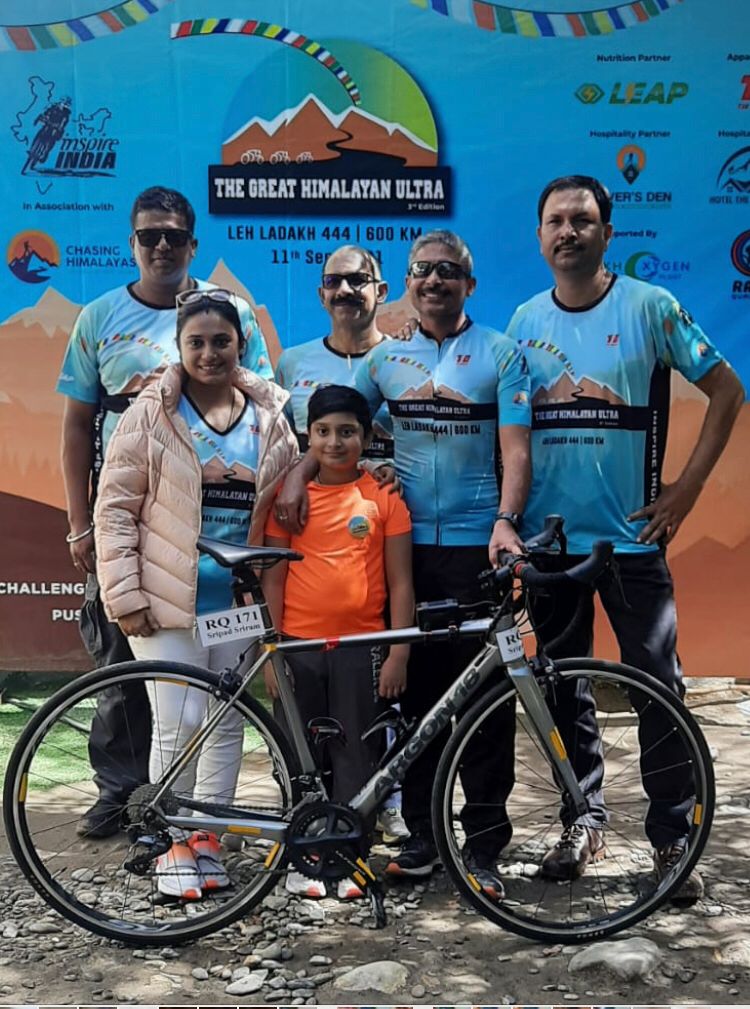
Great Himalayan Ultra (11 September 2021)
Leh-Nurla (115 km)
The dawn of 11 September welcomed us with a steady drizzle. We lined up at the start point by 5 AM and kicked off one after another at 5.30 AM. We had to ride in the opposite direction till Thiksey Monastery and then turn back again towards Leh and then continue our way to Dras through Kargil. It was fairly cold and the rain didn’t make it any easier. We had a timeline in place but I told my crew that it was flexible and not to adhere too much to those timelines. By the time we crossed Leh after turning back from Thiksey, 4 riders had already crossed me. The going was tough but I was confident of catching up. The climb to Gurudwara Pathar Sahib is tough. It is continuous and the worst part is that it seems like a flat and yet one has to labour hard at high cadence and low speeds. From Pathar Sahib, the route rolls down to Nimmu and I flew on that patch. After crossing Nimmu, I halted briefly to change my water-sodden socks which were making my toes numb with the cold. Then the Basgo climb looms ahead after a short respite at Nimmu. I was doing fine and there were no major concerns. But I was definitely not eating enough to fuel me up. Prior to the event, we had discussed what my eating options were and me being a fussy eater, we had a very limited menu to choose from. I thrive on rice and my go-to food is curd rice. But obviously, I couldn’t be on that alone. We were carrying dates, figs, bananas and potato chips to supplement me at timely intervals. Yet, I wasn't eating sufficient amounts. The same was true of my electrolyte intake. I consume Enerzal mixed in water and I wasn't drinking enough. My crew was insisting that I do, but I was brushing them off.

Nurla-Fotu La-Budhkharbu (188 km)
I crossed Nurla in fairly good spirits. Two riders were still behind me and I was enjoying the ride. Around the same place my wife and son crossed me in a vehicle en route to Kargil. At Khaltse, my crew stopped me forcefully to feed me a samosa. I reluctantly consumed it and told them to relax since I could sense that they were tense and serious. I told them that I was completely in rhythm and there was nothing to worry about. I had done this route multiple times so I knew exactly what to expect. I was bracing myself for the impending Lamayuru and Fotu La climbs which were important. We took a short break at the base of the Lamayuru climb to quickly consume a banana and then I took off. It is a stiff and steep climb to Lamayuru and then it eases a bit and then again climbs up to Fotu La top. I took two breaks en route to Fotu La and reached the top by 4 PM. I was slightly behind schedule but nothing that could not be compensated. We rolled down till Haniskot and again climbed till Budhkharbu. At Budhkharbu, we took a break to replenish. I had some dal rice but did not enjoy the food as much. It was cold and it was raining and I was feeling the cold with all the wet clothing. The break at Budhkharbu stretched beyond what we would have hoped for.

Budhkharbu-Kargil (258 km)
Beyond Budhkharbu, I started to tire. My body wasn't getting enough fuel in terms of nutrition and hydration and the energy was getting sapped pretty quickly. We climbed Namik La and then rolled down to Mulbekh, but with frequent halts. We had planned to reach Kargil by 6 PM and I could only reach Namik La top by then. We still believed that we were OK. From Mulbekh also it was a slow ride till Kargil which we finally hit by 8 PM. There was one more rider, Mustafa, who was riding immediately ahead of me and we both started from Kargil towards Dras at around the same time. At Kargil, my wife tried to force-feed me some hot Khichdi, but I consumed very little. My list of mistakes was increasing.
Kargil-Dras (318 km)
We started from Kargil by about 8.30 PM and I thought we would reach Dras control point by 11.30 and how wrong I was. The mistake I made was to underestimate this stretch by a mile. The entire route is a steady climb and at places, steep too. I did not realise this as I had never ever ridden a cycle on this stretch. It wouldn't be an overstatement to say that this passage of the race broke my will to ride. I was tired, fatigue had crept into my limbs and my mind had started to give up. I was taking frequent halts too. I was lagging behind and my crew was losing hope. I’m sure they would have been disappointed with my pace but they did not show it. It was still raining and very cold. I made slow and painful progress. Halfway to Dras, my course mates were waiting for me with fresh curd rice at Thasgam. It lifted my spirits to see them but I couldn't consume much. A few km after Thasgam, I halted and asked AK sir if it was prudent to continue the race. I thought we should think of the Guinness attempt and preserve the body rather than get fatigued so much in this ride that the body doesn't recover in time for the Leh-Manali ride. He was definitely surprised at this thought process and told me not to think and just ride till Dras. I continued reluctantly. Beyond Bhimbat (10 km short of Dras), I was riding only because AK sir kept motivating me (and shouting expletives) to make me ride. I did not want to. The cut-off at Dras was 1.30 AM and I was dangerously close to missing the cut-off. After what seemed like an eternity, we finally made it to the control point at 1.25 AM.
Beyond Dras
We started back after a brief break and Mustafa was just ahead of me. So, all was not yet lost. I was still within cut-off timings but I needed to reach Kargil by 4 AM to still remain in the race. I was riding slowly and my mind was shutting down. Sleep deprivation had set in and there were times when I was dozing off while riding and had to pinch myself, shout out and think of my wife and son waiting at Kargil to keep myself on the saddle. Halfway to Kargil, I was dozing off repeatedly. My crew observed me and asked me to halt and take a power nap in the car. I happily obliged. The warmth of the car as compared to the rain outside further demoralised me. I woke up and started riding again and still kept dozing off while riding. It was getting risky. And because of the slow pace, I was definitely going to miss the Kargil cut-off time. My crew decided that it was enough and pulled me out of the race. I did not once protest. We went back to Thasgam and crashed into the warmth of one of the guest rooms. My crew informed the organisers and my wife about our decision to quit the race and my wife kept insisting that they push me to ride till Kargil where a mandatory 4-hour halt would make good my sleep requirement. But the die was cast. I quit the Himalayan Ultra after riding 340 km in approximately 23 hours!
The Ignominy of Quitting
The next morning was difficult. Quitting is shameful, especially for someone from an Armed Forces background. If I were completely honest with myself, I had lost the will to ride beyond Dras. My mind had given up. I don’t blame my crew. They are required to take decisions during the course of the race and whatever they deem correct shall be followed. It is the crew’s task to decide these things since the rider is not always in the best of his/her mental faculties. But I knew I could have gone till Kargil and my wife knew that too. She was sorely disappointed by the decision to quit. After a 4-hour sleep break at Kargil, probably I could have pushed till Leh. But these are all conjectures now and hindsight is very cruel. The bottom line is that the next morning, we made it back to Leh in our vehicle with a fatigued body and a shattered mind. This was my cross to bear.
The Post-Mortem at Metta Cafe (13 September)
We returned to Leh by the evening of 12 September. The dejected me stayed in for solitude rather than for recovery. My wife attended the award ceremony of the Himalayan Ultra on 13 September where other riders and crew inquired about me. Mustafa, who was just ahead of me at Dras, had completed the ride despite not being in RAAM qualifying time. Kudos to him and all the other riders. Sumit and Kabir expressed the intent to meet up and discuss what went wrong for us. We decided to rendezvous at Metta Cafe along with my crew. There were serious question marks on the future. The Leh-Manali ride was scheduled for 25 Sep which was less than two weeks away. I had lost confidence in myself and I was not very sure if my crew had faith either. Regardless, we decided to sit and analyse the entire ride. So there we were - Ramya, AK Sir, Satish sir, Kedar Joshi, Sumit, Tanvi, Kabir and Jyothi (Kabir’s crew member and Bharat Pannu’s crew chief when he did Leh-Manali the previous year).
The bottom line was that we did not plan our nutrition and hydration properly and that was the reason I could not carry on. My crew was also candid in accepting that they did not have a clue as to what I preferred to eat and drink and also the fact that we managed to assemble at the last minute and therefore the planning was utterly inadequate. We, however, agreed that I should have carried on and completed the ride instead of quitting midway. The general consensus was that I should not attempt the Guinness record this year and wait for the next summer which would give us time to prepare and make a fair attempt. There was also this aspect of road conditions that was highlighted by Sumit and AK sir wherein a 22 km stretch between Brandy Bridge and Sarchu Nala was completely devoid of any tarmac and was under construction by the BRO. That stretch could seriously affect our timings and it was only expected to be repaired by the end of the season. “The Leh-Manali route is not going anywhere. Attempt it next year”, they all said.
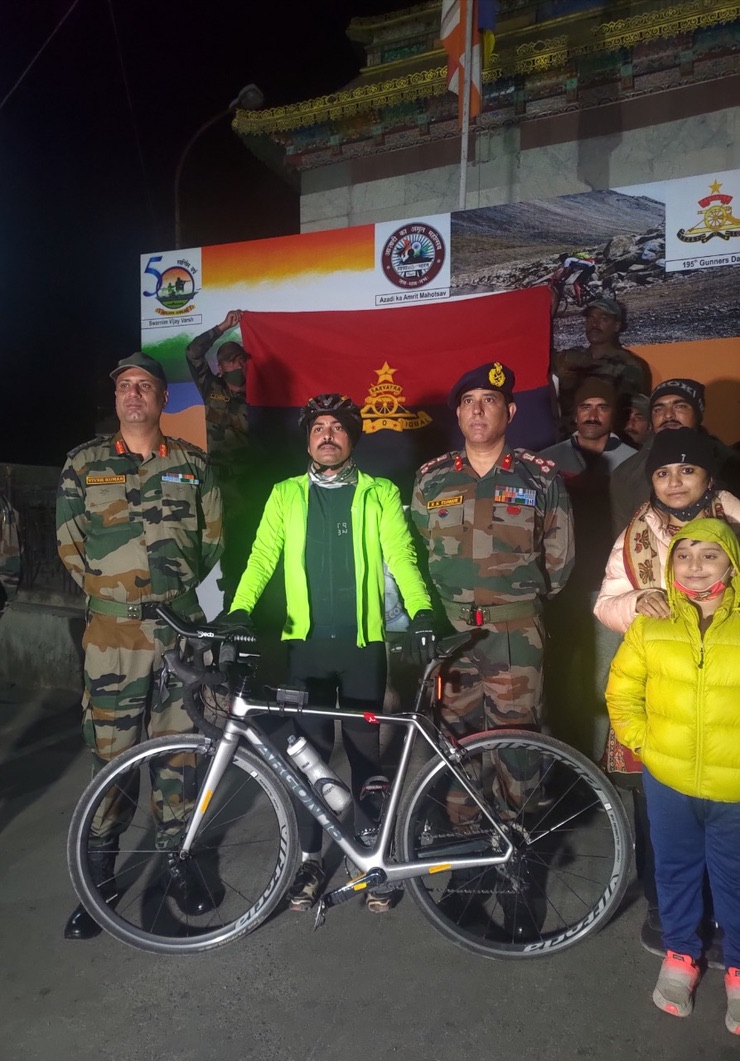
But how could I now take a back step? A major part of the Army organisation had already chipped in for 25 Sep 2021. The stage was set and the event was being included as part of ‘Azadi ka Amrit Mahotsav’ and as an event to commemorate 195th Gunners’ Day celebrations. There was too much at stake for me to back down now. I was adamant that I would go ahead whether or not the crew agreed. There were fierce debates, arguments and counter-arguments. My wife supported my decision. We wanted Sumit to join our crew for the Guinness attempt. His inclusion would greatly boost our crew in terms of experience, especially considering that he knew the entire Leh-Manali route like the back of his hand. Kedar Joshi would be leaving and could not come back for the Guinness attempt and we were acutely short of crew members. Sumit understood the situation and predicament and he said he was returning to Mumbai but would come back to Leh and join our crew if I definitely decided to go ahead with the ride. His only condition was that I should first recce the route and satisfy myself that the ride was possible under the current road conditions. Come to think of it, I had not once seen the route on which I was attempting to break a world record! AK Sir and Satish sir agreed to return to crew for me too. But the general feeling among everyone was not very optimistic and they were hoping that I heed their advice and drop the plan for this year.
What did I feel? The thought of not doing the ride did not occur to me at all. Granted that I had quit the Himalayan Ultra but that was primarily because my mind gave up midway. If I had just shown a little more mental fortitude, I could have finished the ride. Yes, the route recce was important and that was a good outcome of this meeting.
On that note ended our iconic Post-Mortem.
The Route Recce
On 17 September, we embarked on the route recce to ascertain the feasibility of attempting the ride and seeing the route first-hand. It would have been plain stupidity to cycle the route without even seeing it once. I’m glad my crew coerced me into doing this exercise even if their intention was to dissuade me from attempting the ride. The road from Leh to Pang was good, barring minor patches. From Pang, the road deteriorated into a gravel track which was narrow and climbed steadily up to Lachung La. From Lachung La to Whiskey Nala was bad with descent all through. The road again climbed to Nakee La and then descended to Sarchu Plains through the famous Gata Loops. This stretch of the road was good too. The worst stretch was after the Gata Loops from the Brandy Bridge to Sarchu Nala. To my horror, I saw that there was no road at all. It was just a stretch of sand and rocks. Even the trusted Maruti Gypsy had to move on 4x4. There was no way a road bike could be ridden on this patch which continued for 22 km. From Sarchu the road was good till Killingsarai and then a very bad patch of 1 km which could not be ridden. The road to Baralacha La was intermittently good and bad where I would have to dismount from my bike and walk in a few locations. The descent from Baralacha La to ZingZing Bar was okay and then it improved till Patseo and then to Darcha and to Rohtang La. The descent from Rohtang to Manali was not great and was strewn with a lot of potholes and road construction activity. By vehicle, we took 16 hours to reach Manali.

We took a day at Manali to explore the surroundings and started back to Leh on 19 September. This time, I was making a note of the major points in the route and doing a mental mapping of the entire ride. I also formulated a rough time plan for my ride with plans to reach specific locations at specific times. Upon reaching Leh, I told my crew that I would be attempting the ride. They accepted my decision and promised to be there. I had a detailed talk with Sumit in which we went over the entire route breaking it into segments and assigning time for each segment till Manali. At the end of the call, we realised that as per our time plan, we were reaching Manali in 35 hours and 30 minutes. The previous record was 35 hours and 32 minutes. I congratulated Sumit on us breaking the record by 2 minutes! His response was that even if we break it by 2 minutes, it is still a new record. Couldn't argue with that logic. Sumit was on board and reaching Leh in the next couple of days.
I called up my crew and told them of my decision to attempt the record and they accepted. I also made it clear that I have not become a better rider overnight (since the Himalayan Ultra) and that we need to plan and prepare well for us to get this done. I said the aim is to break the record and how it is to be executed is for all of us to work out. It was that simple.
The Crew
Since Kedar Joshi was not returning to crew for this ride, we were left with AK sir and Satish sir. Sumit replaced Kedar Joshi but we were still short of crew members because we wanted to use two support vehicles for this ride. One ahead, looking after my nutrition and hydration and one following me behind at all times. I called up Pradeep sir who was posted down South and he promptly agreed to join. Nitin sir also got on board and thus we had 5 crew members plus my wife who was to assist in the nutrition aspects. The entire crew was to assemble at Leh by 22 September to go over all the preparations and to cover finer aspects of planning.
The External Support (And Noise)
I have mentioned earlier too that I received a lot of support from my family, friends, school group, the Army and the cycling community. One has to be fortunate to get so much support as I did. I was lucky to be surrounded by good people who wanted to see me succeed. The Artillery had pitched in and provided financial and moral support. My parent unit was cheering for me and two of my ex COs had joined my crew. My wife was with me in Ladakh from the first week of September and was doing her best to enable me to achieve these aims of mine. I must mention that the cycling community is a wonderful and vibrant group of selfless people who share a common joy of cycling and I am extremely fortunate to have garnered tremendous support from all corners. Where there is support, there is noise too. We have no control over it. The best thing of course is to ignore it but that is easier said than done. I was disturbed and that noise acted as a catalyst to drive me to break the record.
I was no longer thinking of just attempting. I was now focussed on breaking the record. There was a lot at stake, not least the trust that so many people had in me. I told Sumit and Nitin sir that come what may, this record had to be broken, whatever be the costs. The news of me attempting the Guinness record had already been tweeted by Army handles and news channels too so it was no longer a secret and I was already receiving wishes from many people who wanted to see me achieve the landmark.
The Route: Leh-Manali or Manali-Leh?
The Leh to Manali route traverses 5 major passes - Tanglang La (the highest pass en route at 17,500 Ft), Lachung La, Nakee La, Baralacha La and finally the Rohtang La. The same passes have to be tackled when one rides from Manali to Leh (obviously!) and there is a common misconception that Leh to Manali is just rolling down while Manali to Leh is the real climb. Manali to Leh elevation gain is approximately 2000 metres more than Leh to Manali elevation gain but that does not translate into the fact that Leh-Manali is a descent. One still has to climb all these passes either way. And more importantly, Guinness recognises the attempt from Place ‘A’ to ‘B’ as well as from ‘B’ to ‘A’. The previous record was from Leh to Manali and I did exactly that.
For the benefit of all, I shall describe the route. Leh - Karu - Upshi - Rumtse - Tanglang La - More Plains - Debring - Pang - Lachung La - Whiskey Nala - Nakee La - Gata Loops - Sarchu - Killingsarai - Baralacha La - Patseo - Darcha (Himachal Pradesh) - Jispa - Keylong - Tandi - Sissu - Khoksar - Rohtang La - Marhi - Gulaba - Manali. The total distance covered is 472 km and the total elevation gained is close to 7000 metres. I would like to highlight that Guinness did not permit me to use the Atal Tunnel so I had to go over the Rohtang pass. The previous record by Bharat Pannu was 35:32 and that was what we aimed to better in our attempt.
Can Anyone Create A Guinness Record?
Prior to attempting any Guinness record, one has to apply on their website. It is not guaranteed that approval will be given. I honestly do not know how and why some applications are accepted while others are rejected. During the attempt, Guinness authorities need a set of evidence that needs to be submitted after completion for the validation of the attempt. I will highlight a few as under:
Two prominent witnesses at the start and finish points (certificates).
Witness statements from random people en route.
2 minutes of video footage every hour of the rider cycling with a time stamp.
All halts taken are to be video-recorded and submitted.
Log sheet of the entire ride with location, time and latitude/longitude and altitude.
GPX file of the ride recorded on a cycle computer (Garmin in my case).
Photos of the ride.
News/media articles, if any.
Once the entire set of evidence is submitted to Guinness, it is examined in detail and the attempt is either validated or rejected by them.
Another aspect that Guinness was very particular about was that the rider could use only one bike for the entire race. One wasn’t permitted to change bikes during the ride unless the bike was damaged beyond repair. After my route recce, I wanted to use a mountain bike for the 22 km bad road stretch between Brandy Bridge and Sarchu Nala and I had a discussion with Sumit on this aspect. He said, either we do it by adhering to the Guinness protocols or we abandon the attempt completely. I agreed with him and dropped the mountain bike idea. Which meant that since that particular stretch could not be ridden with a road bike, we had to dismount from the bike and walk. Severe time penalty!
Leh-Manali Ride Plan
So the crew assembled by 22 September and got to work on the ride. The major headache that we faced was my nutrition plan. I promised my crew that I would eat whatever they gave me without fuss (which wasn’t true). Sumit calculated that I needed approximately 300-350 calories per hour to keep me going. This calculation was based on some of my long indoor rides that I had done while in Ladakh and the data taken out from Strava on what my energy consumption was during rides. They asked me my choice of food and we homed in on a few items that were to form part of the nutrition plan. These were - curd rice, dal rice and potato fry rice (as major meals at intervals of 4 hours) and dates, figs, idli, Swiss roll cake and Little Hearts (as hourly intake) to compensate for the 300 calories. I was to drink 700 ml of Enerzal every hour. The crew was divided into two vehicles - ‘A’ and ‘B’ as under:
Vehicle ‘A’ - AK Sir and Nitin sir with the responsibility of providing me my food and hydration at prescribed intervals while moving ahead of me and also entrusted with the responsibility of evidence collection throughout the route.
Vehicle ‘B’ - Pradeep sir, Satish sir and Sumit with the responsibility to follow me at all times and look after the mechanical issues and other minor things. They also suffered my choice of songs blaring out from the vehicle all along the route!
Important Ground Rules Certain rules that were not to be compromised were - Firstly, no power naps at all. Not one minute, not 10 minutes. I was only to sleep after I finished my ride at Manali. And the second one was to never stand near a heat source like Kero heater or Bukhari even if we took breaks en route. This was to avoid the body getting into a cosy state and into slumber, especially when the temperatures were sub-zero.
23 & 24 September
While my crew worked overtime to get everything in order, I was required to rest, eat and hydrate adequately. It was not very easy as I am not accustomed to uninterrupted and long sleep and there were times when I had to be forced to go to bed or to eat. We had initially planned for a 6 AM start from Leh on the 25th of September but considering the dynamics of high-altitude terrain where weather changes dramatically after midday, we changed it to a 4 AM start so that we would cross Tanglang La by 12 PM, if not earlier. My brigade commander was flagging off the ride and elaborate preparations were made at the start point (Leh Gate) including media presence. I slept fitfully.
25 September
I woke up at 1 AM to freshen up and get ready. Leh was an hour’s ride from my location and we had to start for Leh by 2.30 AM at the latest. We reached the start point by 3.30 AM. My wife surprised me by carrying out a covert religious act to ‘cast off evil eyes’! I had to answer a few questions from the media people who had come to cover the event. We did a few last-minute checks on our bike and then there was a formal Aarti by the unit Pandit ji after the arrival of the Commander and we were ready to GO. We were flagged off amid huge cheers and I started my ride at 04:00:11 (Hours:Minutes:Seconds).
Leh-Upshi (47 Km/06:00:00/25 Sep)
As it generally happens, the butterflies in the stomach prior to the start of an event quickly gave way to a sense of liberation. The wait was over and we were in the business end of the record attempt. It is very important to remember why one is riding and that is for the joy of it. The down slope till Choglamsar helps in getting into a smooth and easy rhythm too. It was a slight drizzle in the morning air but not too cold and definitely not heavy. I reminded myself that I needed to eat and drink without fuss. A lot depended on this aspect and I was sure my crew would not take it too well if I floundered. Again. Our start was steady and we were not rushing; it was a long haul, not a sprint. We crossed Upshi at exactly 6 AM and as per our timelines.
Upshi-Rumtse (80 Km/09:00:00/25 Sep)
From Upshi, it is a gradual and steady climb all the way to Tanglang La. One cannot hope to ride at a quick pace because the climbs require you to keep changing the gears. The road is narrow too. The sun had broken out of the clouds and it had stopped raining. We were on track with our nutrition and hydration. Vehicle ‘A’ was carrying out its task with absolute discipline and Vehicle ‘B’ followed me blaring out my choice of songs. There was fresh snowfall at Rumtse and the overall ambience was positive. Sumit had told me to not think too much and I was just trying to take in the beautiful surroundings and pedal. We took a very short break to put on an extra layer of clothing as it was getting colder and I interacted with my crew who were in great spirits too.
Rumtse-Tanglang La (109 Km/12:26:00/25 Sep)
After crossing Rumtse, we could see the snow-covered Tanglang La ridge. Fresh snow has a different feel to it. The sun was out in all its glory even if the riding had become difficult due to the climb. I had cycled this route earlier which helped because I could pace myself. Pushing too hard on these climbs is not recommended because it can result in cramping up and suffering throughout. In between, my crew members were running alongside me shouting out words of encouragement. After reaching the base of Tanglang La, the climb gets steeper and the going gets slower. I took a couple of breaks in between to stretch out and give some respite to my limbs, but the breaks were very very short. We finally reached Tanglang La top by 12:26 which was behind our stated schedule. Tanglang La is the highest point of this entire route and the first of the 5 passes that need to be crossed and is at 17,500 feet. It was to be summited by 12 PM and after a break for a solid meal, we were to start again by 12:15. I could hear some members mentioning that we were behind schedule but I very firmly told them not to think about it as we had segments where we could compensate. I felt my head begin to ache (I have a migraine problem) and so I took a pill and Pradeep sir gave me a quick head massage.


Tanglang La-Pang (179 Km/15:30:00/25 Sep)
We resumed from Tanglang La at 12:40 after a good break and diet, feeling rejuvenated. The route till More Plains is a complete descent and I was flying down that road. The only issue being the number of potholes that littered the road which required me to check my speed, swerve and slow down repeatedly. After 35 km of descent, the road then rolls up and down till a few km short of Pang and again descends steeply into Pang. This stretch of More Plains is pure bliss in terms of the landscape and natural beauty. We crossed several motorcyclists who do this road biking as a revered trip to Ladakh. Very many of them encouraged us by raising their arms in a thumbs-up gesture. The descent into Pang was exhilarating. I felt in great spirits and shape and there was no sign of any fatigue - physical or mental. We crossed Pang by 1530 and took a short break to loosen up the limbs. We were 30 minutes behind schedule.
Pang-Lachung La-Whiskey Nala (203 Km/18:16:00/25 Sep)
After Pang, the road deteriorates and is more of a gravel patch than a tarmac. This obviously impacts a rider’s speeds as a road bike gets impacted by these kinds of surfaces. To add to that, the narrow road also poses a problem because of the traffic that plies on this route which includes trucks too. The road also climbs all the way up to Lachung La which is the second of the 5 passes en route. I started to feel tired on the climb and took my time to slowly make the ascent. It was great to see my crew members atop Lachung La cheering me up as I approached the top. Lachung La stands at an altitude of 16,600 feet. We did not halt there and continued on the descent to Whiskey Nala. It is a steep descent but the gravel road is in bad shape. There were potholes, loose stones and sandy patches that needed to be avoided and I did not have the luxury of rolling down at high speeds. The jerks that the body was subjected to because of these road conditions were making my limbs very painful and my arms quite numb. I was praying for no more descents because of this painful experience. We reached Whiskey Nala at 1816 hours just as the sun bid adieu to us. We were about 45 minutes behind schedule.
Whiskey Nala-Nakee La-Gata Loops-Brandy Bridge (227 Km/20:00:00/25 Sep)
We took a short halt at Whiskey Nala to recharge ourselves. I had an omelette at the cosy and homely Dhaba and we did a quick change of socks and I put on some extra layers. We resumed from Whiskey Nala at 1835 hours and started climbing to Nakee La. The roads were terrible and the going was very laborious. I was relying heavily on the headlights of my follow-on vehicle because of the darkness and also due to the traffic from the opposite direction. Safety was important and I prioritised it over speed. I was prepared for this slowing down on this stretch. After climbing Nakee La which is at an altitude of 15,550 feet, we continued straight through the Gata Loops without halting. By now it was pitch dark and the blind turns of Gata Loops were not easy to navigate. There was one instance when I almost went off the road towards the valley and at the last minute steered towards the road. Phew! Finally we descended the Gata Loops and headed towards the Brandy Bridge which is the commencement of the Sarchu plains. We had almost traversed half our route in approximately 16 hours!
Brandy Bridge-Sarchu (254 Km/22:31:00/25 Sep)
The most harrowing of the road stretches began after we crossed the Brandy Bridge. I had recced this route and we knew what to expect. This was the stretch where I had wanted to use a mountain bike but could not violate the Guinness protocols. This was a 22 km non-existent road stretch. I had to dismount and walk for the better part of this road. My crew were moving ahead to ascertain if there was any road patch that I could ride and there were few and far between. We were crossing small rivulets, stone dumps and loose sand in this entire route. Not only did this severely impact our time-plans but it also affected the psyche of the rider and crew. But my crew did their best to lift up my spirits by talking constantly, pepping me up and cheering throughout. After what seemed like an eternity, we finally reached Sarchu Nala which was the end of this terrible patch. We could see the lights glowing in the distant Sarchu, yet it seemed so far to me. We finally reached Sarchu at 22:31 hours. I was supposed to take a halt here and put on additional layers and have a solid meal before embarking on the climb to Baralacha La. The temperature was hovering around minus 8.
Sarchu Halt
At Sarchu, before I could do any of the other things, I had to attend to the call of nature. I then put on additional layers including changing the base layers since it had already been more than 18 hours of riding since Leh. I then had to swallow down food which my crew served up. All these took more time than we anticipated and it turned out to be a longer break than we had planned and anticipated. By the time we were ready to resume our ride from Sarchu, it was 23:15 hours. I was frustrated because of the long halt and in my own mind, we were 2 hours behind schedule. I did not tell the crew but I was losing hope of breaking the record. However, I had no doubts that I would finish the route. Quitting the Himalayan Ultra was bad enough without adding this to the list too. My crew was upbeat. Sumit especially seemed in good spirits and he said we were 15 minutes ahead of schedule. I thought he was just trying to boost me up.
Sarchu-Baralacha La (284 Km/02:45:00/26 Sep)
Baralacha La was a 30 km climb from the Sarchu plains. It is the 4th of the five passes and stands at an altitude of 15,900 feet. As we resumed our ride from Sarchu, I could feel the cold and the winds. My hands were getting numb and the wind was adding to the chill factor. To top it all, I started feeling sleepy. I was dozing on my bike while riding. My crew saw me and were honking repeatedly to jolt me out of the sleep. After observing me for a while, they stopped me and poured water on my head in addition to giving me a few coffee shots to get me back into riding shape. I could feel the ghosts of the Himalayan Ultra return and resolved to fight off the urge to lie down. It was close to midnight and the body was feeling the fatigue and the sleep deprivation. It was better after this intervention by the crew. I rode steadily till Killingsarai where we had to dismount and walk for a kilometre because of the bad roads. The climb gets steeper from there. It was past midnight and an eerie sense of calm had descended over the night air.
En route to Baralacha La top, we had to dismount at a number of places because of bad roads. I remember having a conversation with Nitin sir during one of those bad patches where he was walking alongside me and we were discussing my first ever 200 km brevet in 2019. We were posted together in Bikaner and I had come back after quitting the ride at 90 km. I told him then that this quitting business was very shameful and I would complete my SR someday. Going down memory lane made me forget the pain and sleep. I get goosebumps even now when I recollect that moment. We finally made it to Baralacha La top at 02:45.
Baralacha La-ZingZing Bar-Patseo (311 Km/04:15:00/26 Sep)
The descent from Baralacha La was again typical - filled with potholes which prevented a steady high speed. But crossing Baralacha La was like a boost to the sagging spirits. We only had to worry about Rohtang pass after this. It is funny how we fool ourselves to make it sound better and easier. And ultra rides are all about fooling your mind! While descending Baralacha La, I could see the tail lights of my crew vehicle ahead and the headlights of my vehicle behind and there was this stretch of monotonous riding where I could hear the songs playing behind me as I rode down. Sleep deprivation had got hold of me and I had started to hallucinate. I was wondering where the other riders were and why I was riding alone. It took a long time for me to realise that I was the only rider!
We again had to dismount and walk after crossing ZingZing Bar because of bad roads. Then the roads got much better and we made good time till Patseo. We reached Patseo by 04:15 where we had a 15-minute tea break. I was very upbeat here. I was telling Sumit that we were doing OK since Darcha was just 30 minutes away. He didn't say anything and just nodded his head.
Patseo-Darcha (329 Km/05:25:00/26 Sep)
We resumed from Patseo at 0430 hours and I thought good roads and downhills would lead us to Darcha by 5 AM. I was in for a rude shock as we faced horrendous roads and climbs en route to Darcha. Frustration got to me along with the tiredness as each pedal stroke became more and more painful. I had started to feel sleepy again and was trying my best to ward it off. I must definitely have dozed off on the bike multiple times without my crew noticing which was dangerous. We finally reached Darcha at 05:25 hours. At the Darcha check post, we halted for a short break. The sun was breaking through on what was a Sunday morning. We had covered 329 km in about 25 hours. Ideally, I wanted to be at Darcha by 4 AM, so I was an hour and a half behind schedule, but the morning air had a positivity to it. I felt fresh and rejuvenated. Sumit said we had 140 km to cover in about 10 hours. He told me to take it as a Sunday morning ride forgetting that we had been riding for the past 25 hours. And that worked wonders. Looking at a fresh rider, my crew was also upbeat. That was the time I told myself that the record was getting broken!
Darcha-Tandi (371 Km/08:00:00/26 Sep)
We rode at a decent pace from Darcha onwards. The roads were intermittently good and bad but definitely not deal-breakers. The route was also rolling with a good amount of climbs, flats and a few descents. The weather had become pleasant and I had to shed off a layer or two because the cold had reduced too. We crossed the Tandi bridge and had planned for a short breakfast break at Tandi. We reached Tandi at 8 AM sharp and took a halt of 15 minutes to get a change of clothing and a quick bite.
Tandi-Khoksar (401 Km/10:17:00/26 Sep)
We resumed from Tandi at 0815 hours in great spirits. I was hoping to reach Khoksar (base of Rohtang La) by 0930 hours. It was about 30 km from Tandi and in my mind, it was all downhill. How wrong was I? Once we resumed, I realised that it was a lot of steep climbing and that really hit me hard. This happened because I had only seen this route once and that too in a vehicle. My pace really went down drastically. I was losing hope by the minute. After a while, there were long descents too. After crossing Sissu, Vehicle ‘B’ pulled alongside me and Sumit asked me to attack the descents more aggressively. He had refrained from giving any suggestions to me till now and I could sense that he too was feeling the heat and we were really moving very slowly.
I conserved myself on the climbs by making sure to not cramp up and I really put my bike through its paces while going downhill. We finally reached Khoksar at 10:17 and ahead loomed the mighty Rohtang La.
Khoksar-Rohtang La (422 Km/12:50:00/26 Sep)
We took a 5-minute break at Khoksar before embarking on the Rohtang climb. It was a 21 km climb and Sumit asked me to cover it in 3 hours. My usual time for climbs is approximately 9 km in one hour but since I was tired, I was thinking of 8.5 km in one hour and I said I would reach the top in 2.5 hours. He again said 3 hours is fine. And we started. Here, Sumit shifted to Vehicle ‘A’ and they were driving ahead of me. Prior to the event, I had managed to get hold of the Hunter Squadron Flag (my squadron in NDA) because I wanted to pose with the flag on successful completion of the ride. Unknown to me, Sumit had taken the flag out and was keeping it handy because he felt that on the Rohtang climb, there would be a requirement of pushing me to ride and they could do that by holding me to ransom with my ‘Hunter’ spirit.
But there was a surprising sense of determination while I was climbing Rohtang. It was the last of the climbs and I had already endured 30 hours of riding without sleep. I was feeling OK, if not great in terms of the fatigue. There was no hint of sleep and I trusted my climbing abilities to take me to the top before 1 PM. There were terrible headwinds en route to the climb. We took two very short breaks to fuel me up and my crew was constantly cheering me up by encouraging words.
The need to take out the Hunter flag did not arise as we made it to Rohtang top by 12:50 PM - exactly 2.5 hours as I had envisaged. There was a great sense of relief among all of us. It was quite cold at the top and someone quickly got me a wind-cheater to protect me from the cold winds. The end was in sight!
Rohtang La-Manali (472 Km/14:54:48/26 Sep)
As we resumed from Rohtang top, the question was not whether the record would be broken, but by what time margin it would be broken. I was thinking of making it to Manali by 14:30 which would give us an hour’s lead over the existing record. It was all downslope to Manali but the road was under repair in many parts and potholes were abundant. I had to dismount multiple times in this descent too. There was a patch which was so bad that I almost fell off my bike in trying to negotiate it and I told myself to take it easy and not injure myself when we were so close to the end point.
I had started to feel a fever build up and the body start aching up. But it didn't matter. We crossed Marhi and Gulaba and entered Palchan which was the entry to Manali. We crossed some traffic in the markets en route. Finally, at 14:54 hours, we reached the end point near the Manali bridge where there was a smattering of Army, Police, Civil administration and local media to welcome us as we finished this epic ride.
Relief, rather than euphoria, is what I felt as we completed the ride. We were received by the SDM and the DSP at the finish point. I was quickly taken aside for a media interview and then we clicked the mandatory photos with the crew and all others who had assembled. By then, I was feeling very feverish and all I wanted to do was to take a quick shower and go to sleep. After some time, we made our way to the Palchan transit camp for a well-deserved rest and recuperation.
I happened to be at the right place at the right time with the right people and the Guinness record for Fastest Cycling (Men Solo) from Leh to Manali had been broken by 38 minutes!
Post Leh-Manali
There wasn't much time to party at Manali since we were all quite tired. Pradeep sir and Satish sir had to move back so they got a bus to Delhi the same night. AK sir, Nitin sir and Sumit did have a good time in high ‘spirits’ while I was in a deep slumber. The next morning, we freshened up and started back to Leh. That was a memorable ride as we relived the entire route and what each of us felt during different times of the ride. We reached late night and we did party into the early hours of the morning. Each of us had to move immediately for our respective work-related issues soon thereafter.
Acknowledgements
Without my crew, I could not have achieved this feat. They were the difference between quitting at the Himalayan Ultra and finishing at Leh-Manali. They were an extremely spirited, dedicated and selfless bunch of individuals who did not know each other before this event. Getting together like that, planning everything for the ride and then making me complete the ride is no mean achievement. Every member had a separate role - AK sir was solely focussed on my well-being and safety, nothing else mattered to him. Satish sir was the experienced voice, Pradeep sir was the breath of positivity who remained cheerful all through. Nitin sir was the live wire, cheering, running alongside and boosting me up and Sumit was the strategist, forever thinking, calm, composed and the heart of the crew. I will forever remain indebted to this fantastic group. Without Ramya, my wife, I probably would not even have attempted to undertake this ride. From the time I picked up cycling in late 2018, she has always been the strongest pillar of support. I cannot begin to imagine how many sacrifices she has had to make for me to follow my passion. My son, Dhruv, was no less important in this entire scheme of things.
When I needed it most, the Army, as an organisation, rallied behind me and provided support. My schoolmates (Saikorians) were with me in spirit all through the ride. It was overwhelming to see them follow each moment of my ride when I later saw it in our WhatsApp groups. Senior officers of the Artillery had shown tremendous faith in my ability to achieve this record and with that, I gained in confidence too. My family and friends never for a moment felt that I would come back without achieving it. Thank you to all of you. For once, I’m short of words to convey my gratitude.
Work-Life Balance
Does this need to be elaborated? We all are, mostly, working individuals in varied fields. I do not suppose that any organisation spares someone to only follow his/her passion while sacrificing work. We need to juggle between the two. There will be times when one takes priority over the other but that balance needs to be maintained without expecting a lot. It is difficult to discover a passion or to realise what you are good at. Once you do, it would be foolish to not pursue it. It is, after all, one life.
Guinness Certificate & Validation
Despite my crew pushing me to submit the evidence to Guinness as soon as possible, I delayed. Sometimes because of my work commitments and at other times because of my callous attitude. We submitted the evidence quite late and the validation also got delayed. We finally received the certificate in December 2021.
I hope you enjoyed this ride as much as we did. I end this piece with a famous adage from the National Defence Academy (NDA) - 'It's All Mental'. Cheers!






.jpg)


